Advertisements
Advertisements
Question
In deriving Bernoulli’s equation, we equated the work done on the fluid in the tube to its change in the potential and kinetic energy. (a) What is the largest average velocity of blood flow in an artery of diameter 2 × 10⁻³ m if the flow must remain laminar? (b) Do the dissipative forces become more important as the fluid velocity increases? Discuss qualitatively.
Advertisements
Solution 1
a) 1.966 m/s
Diameter of the artery, d = 2 × 10⁻³ m
Viscosity of blood, `eta = 2.084 xx 10^(-3)` Pas
Density of blood, ρ = 1.06 × 10³ kg/m3
Reynolds’ number for laminar flow, NR = 2000
The largest average velocity of blood is given as:
`V_"arg" = (N_Reta)/rhod`
`= (2000xx2.084xx 10^(-3))/(1.06xx10^3xx2xx10^(-3))`
= 1.966 m/s
Therefore, the largest average velocity of blood is 1.966 m/s.
b)Yes
As the fluid velocity increases, the dissipative forces become more important. This is because of the rise of turbulence. Turbulent flow causes dissipative loss in a fluid.
Solution 2
(a) If dissipative forces are present, then some forces in liquid flow due to pressure difference is spent against dissipative forces, due to which the pressure drop becomes large.
(b) The dissipative forces become more important with increasing flow velocity, because of turbulence.
APPEARS IN
RELATED QUESTIONS
Fill in the blanks using the word(s) from the list appended with each statement
For the model of a plane in a wind tunnel, turbulence occurs at a ... speed for turbulence for an actual plane (greater / smaller)
Explain why To keep a piece of paper horizontal, you should blow over, not under, it
Explain why A spinning cricket ball in air does not follow a parabolic trajectory
Can Bernoulli’s equation be used to describe the flow of water through a rapid in a river? Explain.
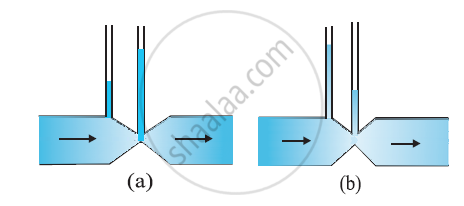
Figures (a) and (b) refer to the steady flow of a (non-viscous) liquid. Which of the two figures is incorrect? Why?
A Gipsy car has a canvass top. When the car runs at high speed, the top bulges out. Explain.
A large cylindrical tank has a hole of area A at its bottom. Water is poured in the tank by a tube of equal cross-sectional area A ejecting water at the speed v.
Suppose the tube in the previous problem is kept vertical with A upward but the other conditions remain the same. the separation between the cross sections at A and B is 15/16 cm. Repeat parts (a), (b) and (c) of the previous problem. Take g = 10 m/s2.
A large number of liquid drops each of radius 'a' are merged to form a single spherical drop of radius 'b'. The energy released in the process is converted into kinetic energy of the big drop formed. The speed of the big drop is [p = density of liquid, T = surface tension of liquid] ____________.
When one end of the capillary is dipped in water, the height of water column is 'h'. The upward force of 119 dyne due to surface tension is balanced by the force due to the weight of water column. The inner circumference of the capillary is (Surface tension of water= 7 x 10⁻² N/m) ____________.
Which of the following is NOT an example of the application of Bernoulli's principle?
Dynamic lift caused by spinning is called ______.
The working of venturimeter is based on ______.
If p0 = 1.03 × 10⁵ Nm–2, ρ0 = 1.29 kg m–3 and g = 9.8 ms–2, at what height will the pressure drop to (1/10) the value at the surface of the earth?
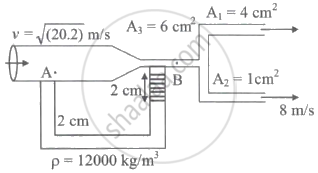
Calculate the velocity with which the liquid gushes out of the 4 cm2 outlet, if the liquid flowing in the tube is water and the liquid in the U tube has a specificity 12. The velocity of the liquid at point A is `sqrt20.2` m/s ______.
Explain the working of an atomizer.
