Advertisements
Advertisements
Question
If a man jumps out from a boat, the boat moves backwards. Why ?
Advertisements
Solution
When a man jumps out of a boat to the bank of the river, the boat moves backwards, away from him. This is due to the fact that to step out of the boat, the man pushes the boat with his foot in backward direction. The push of the man on the boat is the action. The boat exerts an equal force on the man in forward direction which enables him to move forward. This force exerted by the boat on the man is reaction. Since the boat is floating on water and not fixed, it moves backward due to the force exerted by the man.
APPEARS IN
RELATED QUESTIONS
If action is always equal to the reaction, explain how a horse can pull a cart.
Explain, why is it difficult for a fireman to hold a hose, which ejects large amounts of water at a high velocity.
A stone of 1 kg is thrown with a velocity of 20 m s−1 across the frozen surface of a lake and comes to rest after travelling a distance of 50 m. What is the force of friction between the stone and the ice?
A girl weighing 25 kg stands on the tloor. She exerts a downward force of 250 N on the floor. What force does the floor exert on her ?
State Newton’s third law of motion and give two examples to illustrate the law.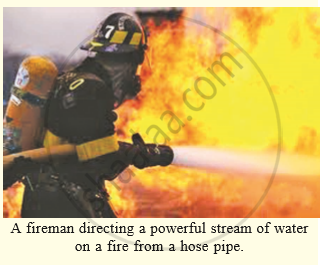
Explain why, when a fireman directs a powerful stream of water on a fire from a hose pipe, the hose pipe tends to go backward.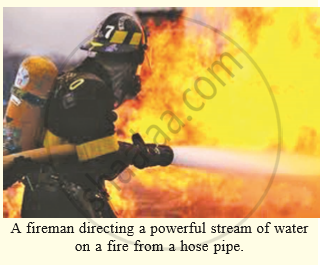
Complete a sentence and explain it.
The working of a rocket depends on Newton's ______ law of motion.
According to the third law of motion, action and reaction
A book is resting on a table. Which of the following is the correct reaction force to the gravitational pull of the Earth on the book?
Can action and reaction forces be noncontact forces?
