Advertisements
Advertisements
Question
If the diagonals of the quadrilateral formed by the lines l1x + m1y + n1 = 0, l2x + m2y + n2 = 0, l1x + m1y + n1' = 0 and l2x + m2y + n2' = 0 are perpendicular, then write the value of l12 − l22 + m12 − m22.
Advertisements
Solution
The given lines are
l1x + m1y + n1 = 0 ... (1)
l2x + m2y + n2 = 0 ... (2)
l1x + m1y + n1' = 0 ... (3)
l2x + m2y + n2' = 0 ... (4)
Let (1), (2), (3) and (4) represent the sides AB, BC, CD and DA, respectively.
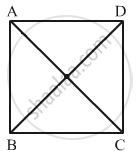
The equation of diagonal AC passing through the intersection of (2) and (3) is given by
l1x + m1y + n1' + \[\lambda\] (l2x + m2y + n2) = 0
\[\Rightarrow \left( l_1 + \lambda l_2 \right)x + \left( m_1 + \lambda m_2 \right)y + \left( n_1 ' + \lambda n_2 \right) = 0\]
\[ \Rightarrow \text { Slope of diagonal AC } = - \left( \frac{l_1 + \lambda l_2}{m_1 + \lambda m_2} \right)\]
Also, the equation of diagonal BD, passing through the intersection of (1) and (2), is given by
l1x + m1y + n1 + \[\mu\] (l2x + m2y + n2) = 0
\[\Rightarrow \left( l_1 + \mu l_2 \right)x + \left( m_1 + \mu m_2 \right)y + \left( n_1 + \mu n_2 \right) = 0\]
\[ \Rightarrow \text { Slope of diagonal BD }= - \left( \frac{l_1 + \mu l_2}{m_1 + \mu m_2} \right)\]
The diagonals are perpendicular to each other.
∴ \[\left( \frac{l_1 + \lambda l_2}{m_1 + \lambda m_2} \right)\left( \frac{l_1 + \mu l_2}{m_1 + \mu m_2} \right) = - 1\]
\[\Rightarrow \left( l_1 + \lambda l_2 \right)\left( l_1 + \mu l_2 \right) = - \left( m_1 + \lambda m_2 \right)\left( m_1 + \mu m_2 \right)\]
\[\text { Let }\lambda = - 1, \mu = 1\]
\[ \Rightarrow \left( l_1 - l_2 \right)\left( l_1 + l_2 \right) = - \left( m_1 - m_2 \right)\left( m_1 + m_2 \right)\]
\[ \Rightarrow \left( {l_1}^2 - {l_2}^2 \right) = - \left( {m_1}^2 - {m_2}^2 \right)\]
\[ \Rightarrow \left( {l_1}^2 - {l_2}^2 \right) + \left( {m_1}^2 - {m_2}^2 \right) = 0\]
APPEARS IN
RELATED QUESTIONS
Find the equation of the line parallel to x-axis and having intercept − 2 on y-axis.
Find the equation of a line equidistant from the lines y = 10 and y = − 2.
Find the equation of the line passing through \[(2, 2\sqrt{3})\] and inclined with x-axis at an angle of 75°.
Find the equation of the straight line which passes through the point (1,2) and makes such an angle with the positive direction of x-axis whose sine is \[\frac{3}{5}\].
Find the equation of the straight line which divides the join of the points (2, 3) and (−5, 8) in the ratio 3 : 4 and is also perpendicular to it.
Prove that the perpendicular drawn from the point (4, 1) on the join of (2, −1) and (6, 5) divides it in the ratio 5 : 8.
Find the equation of the line passing through the point (−3, 5) and perpendicular to the line joining (2, 5) and (−3, 6).
Find the equation of the straight lines passing through the following pair of point:
(a, b) and (a + c sin α, b + c cos α)
Find the equation of the straight lines passing through the following pair of point :
(a cos α, a sin α) and (a cos β, a sin β)
Find the equations of the sides of the triangles the coordinates of whose angular point is respectively (0, 1), (2, 0) and (−1, −2).
Find the equations to the diagonals of the rectangle the equations of whose sides are x = a, x = a', y= b and y = b'.
By using the concept of equation of a line, prove that the three points (−2, −2), (8, 2) and (3, 0) are collinear.
The length L (in centimeters) of a copper rod is a linear function of its celsius temperature C. In an experiment, if L = 124.942 when C = 20 and L = 125.134 when C = 110, express L in terms of C.
The owner of a milk store finds that he can sell 980 litres milk each week at Rs 14 per liter and 1220 liters of milk each week at Rs 16 per liter. Assuming a linear relationship between selling price and demand, how many liters could he sell weekly at Rs 17 per liter.
Find the equations to the straight lines which go through the origin and trisect the portion of the straight line 3 x + y = 12 which is intercepted between the axes of coordinates.
Find the equation to the straight line cutting off intercepts − 5 and 6 from the axes.
Find the equation to the straight line which cuts off equal positive intercepts on the axes and their product is 25.
Find the equation of the straight line which passes through the point (−3, 8) and cuts off positive intercepts on the coordinate axes whose sum is 7.
Find the equation of the line, which passes through P (1, −7) and meets the axes at A and Brespectively so that 4 AP − 3 BP = 0.
Find the equation of the straight line which passes through the point P (2, 6) and cuts the coordinate axes at the point A and B respectively so that \[\frac{AP}{BP} = \frac{2}{3}\] .
A straight line drawn through the point A (2, 1) making an angle π/4 with positive x-axis intersects another line x + 2y + 1 = 0 in the point B. Find length AB.
Three sides AB, BC and CA of a triangle ABC are 5x − 3y + 2 = 0, x − 3y − 2 = 0 and x + y − 6 = 0 respectively. Find the equation of the altitude through the vertex A.
Find the equation of a line drawn perpendicular to the line \[\frac{x}{4} + \frac{y}{6} = 1\] through the point where it meets the y-axis.
Find the length of the perpendicular from the origin to the straight line joining the two points whose coordinates are (a cos α, a sin α) and (a cos β, a sin β).
Find the equation of the straight lines passing through the origin and making an angle of 45° with the straight line \[\sqrt{3}x + y = 11\].
Find the equations to the straight lines which pass through the origin and are inclined at an angle of 75° to the straight line \[x + y + \sqrt{3}\left( y - x \right) = a\].
Find the equations to the straight lines which pass through the point (h, k) and are inclined at angle tan−1 m to the straight line y = mx + c.
Find the equations to the sides of an isosceles right angled triangle the equation of whose hypotenues is 3x + 4y = 4 and the opposite vertex is the point (2, 2).
Two sides of an isosceles triangle are given by the equations 7x − y + 3 = 0 and x + y − 3 = 0 and its third side passes through the point (1, −10). Determine the equation of the third side.
Show that the straight lines given by (2 + k) x + (1 + k) y = 5 + 7k for different values of k pass through a fixed point. Also, find that point.
Find the equations of the lines through the point of intersection of the lines x − 3y + 1 = 0 and 2x + 5y − 9 = 0 and whose distance from the origin is \[\sqrt{5}\].
Write the area of the triangle formed by the coordinate axes and the line (sec θ − tan θ) x + (sec θ + tan θ) y = 2.
If a, b, c are in G.P. write the area of the triangle formed by the line ax + by + c = 0 with the coordinates axes.
The equation of the line passing through (1, 5) and perpendicular to the line 3x − 5y + 7 = 0 is
In what direction should a line be drawn through the point (1, 2) so that its point of intersection with the line x + y = 4 is at a distance `sqrt(6)/3` from the given point.
The equation of the line passing through the point (1, 2) and perpendicular to the line x + y + 1 = 0 is ______.
The lines ax + 2y + 1 = 0, bx + 3y + 1 = 0 and cx + 4y + 1 = 0 are concurrent if a, b, c are in G.P.
