Advertisements
Advertisements
Question
If cos A = `(2sqrt(m))/(m + 1)`, then prove that cosec A = `(m + 1)/(m - 1)`.
Advertisements
Solution
`cos A = (2sqrt(m))/(m + 1)` ...[Given]
We know that,
sin2A + cos2A = 1
∴ `sin^2A + ((2sqrt(m))/(m + 1))^2 = 1`
∴ `sin^2A + (4m)/(m + 1)^2 = 1`
∴ `sin^2A = 1 - (4m)/(m + 1)^2`
= `((m + 1)^2 - 4m)/(m + 1)^2`
= `(m^2 + 2m + 1 - 4m)/(m + 1)^2` ...[∵ (a + b)2 = a2 + 2ab + b2]
= `(m^2 - 2m + 1)/(m + 1)^2`
∴ `sin^2A = (m - 1)^2/(m + 1)^2` ...[∵ a2 – 2ab + b2 = (a – b)2]
∴ `sin A = (m - 1)/(m + 1)` ...[Taking square root of both sides]
Now, `"cosec" A = 1/(sin A)`
= `1/((m - 1)/(m + 1))`
∴ `"cosec" A = (m + 1)/(m - 1)`
APPEARS IN
RELATED QUESTIONS
If `sec alpha=2/sqrt3` , then find the value of `(1-cosecalpha)/(1+cosecalpha)` where α is in IV quadrant.
Prove the following identities:
`(i) 2 (sin^6 θ + cos^6 θ) –3(sin^4 θ + cos^4 θ) + 1 = 0`
`(ii) (sin^8 θ – cos^8 θ) = (sin^2 θ – cos^2 θ) (1 – 2sin^2 θ cos^2 θ)`
The angles of depression of two ships A and B as observed from the top of a light house 60 m high are 60° and 45° respectively. If the two ships are on the opposite sides of the light house, find the distance between the two ships. Give your answer correct to the nearest whole number.
Prove the following trigonometric identities.
`tan theta - cot theta = (2 sin^2 theta - 1)/(sin theta cos theta)`
Prove that:
2 sin2 A + cos4 A = 1 + sin4 A
If 4 cos2 A – 3 = 0, show that: cos 3 A = 4 cos3 A – 3 cos A
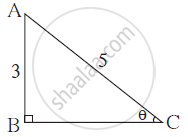
From the figure find the value of sinθ.
\[\frac{x^2 - 1}{2x}\] is equal to
Prove the following identity :
`cosec^4A - cosec^2A = cot^4A + cot^2A`
Without using trigonometric table , evaluate :
`cos90^circ + sin30^circ tan45^circ cos^2 45^circ`
Prove that cosec2 (90° - θ) + cot2 (90° - θ) = 1 + 2 tan2 θ.
Prove that `( tan A + sec A - 1)/(tan A - sec A + 1) = (1 + sin A)/cos A`.
Prove that `tan A/(1 + tan^2 A)^2 + cot A/(1 + cot^2 A)^2 = sin A.cos A`
If `(cos alpha)/(cos beta)` = m and `(cos alpha)/(sin beta)` = n, then prove that (m2 + n2) cos2 β = n2
Prove that `(sin^2θ)/(cos θ) + cos θ = sec θ`.
If `tan θ = 7/24`, then to find value of cos θ complete the activity given below.
Activity:
sec2θ = 1 + `square` ...[Fundamental tri. identity]
sec2θ = 1 + `square^2`
sec2θ = 1 + `square/576`
sec2θ = `square/576`
sec θ = `square`
cos θ = `square` ...`[cos theta = 1/sectheta]`
Prove that (1 – cos2A) . sec2B + tan2B (1 – sin2A) = sin2A + tan2B.
The value of 2sinθ can be `a + 1/a`, where a is a positive number, and a ≠ 1.
Prove that (sec θ + tan θ) (1 – sin θ) = cos θ
Factorize: sin3θ + cos3θ
Hence, prove the following identity:
`(sin^3θ + cos^3θ)/(sin θ + cos θ) + sin θ cos θ = 1`
