Advertisements
Advertisements
Question
If the coordinates of the sides AB and AC of ∆ABC are (3, 5) and (−3, −3), respectively, then write the length of side BC.
Advertisements
Solution
Disclaimer: In the question it should have been the coordinates of the mid points of AB and AC are (3, 5) and (-3, -3) 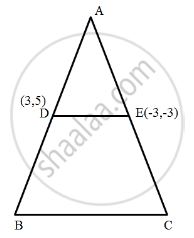
Given: the coordinates of the midpoints of AB and AC are (3,5) and (-3, -3).
Let, D and E be the midpoints of AB and AC, respectively.
\[\therefore DE = \sqrt{\left[ 3 - \left( - 3 \right) \right]^2 + \left[ 5 - \left( - 3 \right) \right]^2}\]
\[ = \sqrt{6^2 + 8^2}\]
\[ = \sqrt{100}\]
= 10 units
Now, as D and E are midpoints of AB and AC respectively,
by the mid-points theorem,
\[BC = 2 \times DE\]
= 2 x 10 units
= 20 units
APPEARS IN
RELATED QUESTIONS
The points A (2, 0), B (9, 1), C (11, 6) and D (4, 4) are the vertices of a quadrilateral ABCD. Determine whether ABCD is a rhombus or not.
Find the coordinates of the centre of the circle inscribed in a triangle whose vertices are (−36, 7), (20, 7) and (0, −8).
The base of an equilateral triangle with side 2a lies along the y-axis, such that the mid-point of the base is at the origin. Find the vertices of the triangle.
Find a point on the x-axis, which is equidistant from the points (7, 6) and (3, 4).
Find the locus of a point equidistant from the point (2, 4) and the y-axis.
Find the equation of the locus of a point which moves such that the ratio of its distances from (2, 0) and (1, 3) is 5 : 4.
Find the locus of a point which is equidistant from (1, 3) and the x-axis.
Find the locus of a point which moves such that its distance from the origin is three times its distance from the x-axis.
A (5, 3), B (3, −2) are two fixed points; find the equation to the locus of a point P which moves so that the area of the triangle PAB is 9 units.
If A (−1, 1) and B (2, 3) are two fixed points, find the locus of a point P, so that the area of ∆PAB = 8 sq. units.
A rod of length l slides between two perpendicular lines. Find the locus of the point on the rod which divides it in the ratio 1 : 2.
Find the locus of the mid-point of the portion of the line x cos α + y sin α = p which is intercepted between the axes.
What does the equation (a − b) (x2 + y2) −2abx = 0 become if the origin is shifted to the point \[\left( \frac{ab}{a - b}, 0 \right)\] without rotation?
Find what the following equation become when the origin is shifted to the point (1, 1).
x2 + xy − 3x − y + 2 = 0
Find what the following equation become when the origin is shifted to the point (1, 1).
x2 − y2 − 2x +2y = 0
Find what the following equation become when the origin is shifted to the point (1, 1).
xy − x − y + 1 = 0
To what point should the origin be shifted so that the equation x2 + xy − 3x − y + 2 = 0 does not contain any first degree term and constant term?
Verify that the area of the triangle with vertices (2, 3), (5, 7) and (− 3 − 1) remains invariant under the translation of axes when the origin is shifted to the point (−1, 3).
Find what the following equation become when the origin is shifted to the point (1, 1).
x2 + xy − 3y2 − y + 2 = 0
Find the point to which the origin should be shifted after a translation of axes so that the following equation will have no first degree terms: y2 + x2 − 4x − 8y + 3 = 0
Find the point to which the origin should be shifted after a translation of axes so that the following equation will have no first degree terms: x2 + y2 − 5x + 2y − 5 = 0
Find the point to which the origin should be shifted after a translation of axes so that the following equation will have no first degree terms: x2 − 12x + 4 = 0
Verify that the area of the triangle with vertices (4, 6), (7, 10) and (1, −2) remains invariant under the translation of axes when the origin is shifted to the point (−2, 1).
The vertices of a triangle are O (0, 0), A (a, 0) and B (0, b). Write the coordinates of its circumcentre.
In Q.No. 1, write the distance between the circumcentre and orthocentre of ∆OAB.
If the points (a, 0), (at12, 2at1) and (at22, 2at2) are collinear, write the value of t1 t2.
Write the coordinates of the circumcentre of a triangle whose centroid and orthocentre are at (3, 3) and (−3, 5), respectively.
Write the coordinates of the in-centre of the triangle with vertices at (0, 0), (5, 0) and (0, 12).
If the points (1, −1), (2, −1) and (4, −3) are the mid-points of the sides of a triangle, then write the coordinates of its centroid.
Write the area of the triangle with vertices at (a, b + c), (b, c + a) and (c, a + b).
