Advertisements
Advertisements
प्रश्न
If the coordinates of the sides AB and AC of ∆ABC are (3, 5) and (−3, −3), respectively, then write the length of side BC.
Advertisements
उत्तर
Disclaimer: In the question it should have been the coordinates of the mid points of AB and AC are (3, 5) and (-3, -3) 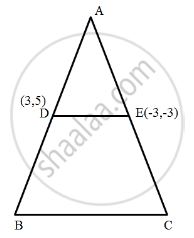
Given: the coordinates of the midpoints of AB and AC are (3,5) and (-3, -3).
Let, D and E be the midpoints of AB and AC, respectively.
\[\therefore DE = \sqrt{\left[ 3 - \left( - 3 \right) \right]^2 + \left[ 5 - \left( - 3 \right) \right]^2}\]
\[ = \sqrt{6^2 + 8^2}\]
\[ = \sqrt{100}\]
= 10 units
Now, as D and E are midpoints of AB and AC respectively,
by the mid-points theorem,
\[BC = 2 \times DE\]
= 2 x 10 units
= 20 units
APPEARS IN
संबंधित प्रश्न
If the line segment joining the points P (x1, y1) and Q (x2, y2) subtends an angle α at the origin O, prove that
OP · OQ cos α = x1 x2 + y1, y2
The points A (2, 0), B (9, 1), C (11, 6) and D (4, 4) are the vertices of a quadrilateral ABCD. Determine whether ABCD is a rhombus or not.
Find the coordinates of the centre of the circle inscribed in a triangle whose vertices are (−36, 7), (20, 7) and (0, −8).
The base of an equilateral triangle with side 2a lies along the y-axis, such that the mid-point of the base is at the origin. Find the vertices of the triangle.
Find a point on the x-axis, which is equidistant from the points (7, 6) and (3, 4).
Find the locus of a point equidistant from the point (2, 4) and the y-axis.
Find the equation of the locus of a point which moves such that the ratio of its distances from (2, 0) and (1, 3) is 5 : 4.
A point moves so that the difference of its distances from (ae, 0) and (−ae, 0) is 2a. Prove that the equation to its locus is \[\frac{x^2}{a^2} - \frac{y^2}{b^2} = 1\]
Find the locus of a point which is equidistant from (1, 3) and the x-axis.
Find the locus of a point which moves such that its distance from the origin is three times its distance from the x-axis.
Find the locus of a point such that the line segments with end points (2, 0) and (−2, 0) subtend a right angle at that point.
A rod of length l slides between two perpendicular lines. Find the locus of the point on the rod which divides it in the ratio 1 : 2.
Find the locus of the mid-point of the portion of the line x cos α + y sin α = p which is intercepted between the axes.
If O is the origin and Q is a variable point on y2 = x, find the locus of the mid-point of OQ.
Find what the following equation become when the origin is shifted to the point (1, 1).
xy − x − y + 1 = 0
To what point should the origin be shifted so that the equation x2 + xy − 3x − y + 2 = 0 does not contain any first degree term and constant term?
Verify that the area of the triangle with vertices (2, 3), (5, 7) and (− 3 − 1) remains invariant under the translation of axes when the origin is shifted to the point (−1, 3).
Find what the following equation become when the origin is shifted to the point (1, 1).
xy − x − y + 1 = 0
Find the point to which the origin should be shifted after a translation of axes so that the following equation will have no first degree terms: y2 + x2 − 4x − 8y + 3 = 0
The vertices of a triangle are O (0, 0), A (a, 0) and B (0, b). Write the coordinates of its circumcentre.
In Q.No. 1, write the distance between the circumcentre and orthocentre of ∆OAB.
Write the coordinates of the orthocentre of the triangle formed by points (8, 0), (4, 6) and (0, 0).
Three vertices of a parallelogram, taken in order, are (−1, −6), (2, −5) and (7, 2). Write the coordinates of its fourth vertex.
If the points (a, 0), (at12, 2at1) and (at22, 2at2) are collinear, write the value of t1 t2.
Write the coordinates of the circumcentre of a triangle whose centroid and orthocentre are at (3, 3) and (−3, 5), respectively.
Write the coordinates of the in-centre of the triangle with vertices at (0, 0), (5, 0) and (0, 12).
