Advertisements
Advertisements
Question
Identify the following structures and explain their significance in renal physiology?
- Juxtaglomerular apparatus
- Podocytes
- Sphincters in the bladder
Advertisements
Solution
1) Juxtaglomerular apparatus: It is a specialized tissue in the afferent arteriole of the nephron that consists of macula densa and granular cells.
- Action: The macula densa cells sense distal tubular flow and aspect afferent arteriole diameter.
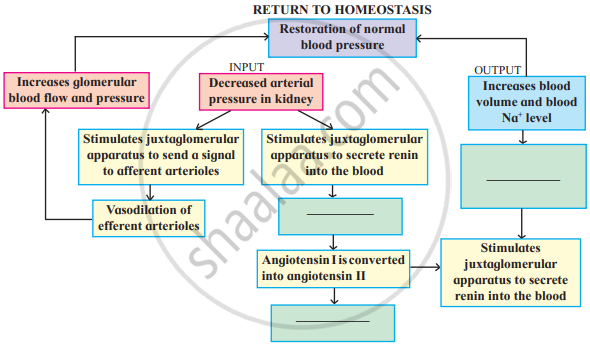
- Actions of Glandular cells: When there is a fall in glomerular blood flow it can activate Juxta glomerulus cells to release renin from the liver which converts angiotensinogen to angiotensin I.
- Angiotensin converting enzyme converts angiotensin I to angiotensin II.
- It stimulates Na+ reabsorption in the proximal convoluted tubule by vasoconstriction of the blood vessel and increases the glomerular blood pressure.
2) Podocytes:
- The visceral layer of Bowman’s capsule is made of epithelial cells called podocytes.
- The podocytes and the foot processes and the basement membrane of the glomerulus act as a filtering membrane.
- Podocytes act in glomerulus filtration.
3) Sphincters in the bladder:
- The sphincters of the bladder regulate urination.
- When the bladder is full the stretching of the urinary bladder stimulates the CNS through the sensory neurons of the parasympathetic nervous system and brings about contraction of the bladder.
- Somatic motor neurons induce the sphincters to close.
- Smooth muscles contract results in the opening of the internal sphincters and relaxing the external sphincter.
- The sphincter opens and the urine is expelled out.
RELATED QUESTIONS
Urea splitting bacteria are responsible for _______ types of stones.
(A) calcium oxalate
(B) calcium phosphate
(C) calcium carbonate
(D) struvite
Write True (T) or False (F) for the following statement. Rewrite the false statement in the correct form.
Removal of solid undigested food is excretion
Draw a diagram of the human excretory system and label the following parts: Kidney, ureter, urinary bladder, and urethra.
What are the symptoms of a urinary tract infection?
Correct the sequence of the following steps to explain the process of urine formation.
1. Blood enters the glomerulus under high pressure.
2. The filtrate passes through the thin walls of the Bowman’s capsule into the renal tubule
3. As the filtrate, passes through the tubule, water, and many useful substances are reabsorbed by the walls of the blood capillaries.
4. Water and small solutes are filtered in the Bowman’s capsule.
5. The remaining liquid, along with waste is called urine and is collected in the urinary bladder.
6. Blood containing waste material enters the kidneys through the renal artery.
Answer the following question.
Doctors say Mr. Shaikh is suffering from urolithiasis. How it could be explained in simple words?
Answer the following question.
John has two options as a treatment for his renal problem: Dialysis or kidney transplants. Which option should he choose? Why?
Complete the diagram/chart with correct labels/ information. Write the conceptual details regarding it.
Stones formed when the urinary tract is infected by urea splitting bacteria are ______
Which of the following is CORRECT with reference to haemodialysis?
Haemodialysis is done in the condition when the person is suffering from ______.
Ultimate correction for renal failure is:
The condition of accumulation of urea in the blood is termed as ______.
Match the abnormal conditions given in Column A with their explanations given in Column B and Choose the correct option
| Column A | Column B |
| A. Glycosuria | i. Accumulation of uric acid in joints |
| B. Renal calculi | ii. Inflammation in glomeruli |
| C. Glomerular nephritis | iii. Mass of crystallised salts within the kidney |
| D. Gout | iv. Presence of glucose in urine |
Which type of kidney stones are formed due to genetic disorders?
Which statement is correct regarding the haemodialysis procedure?
Presence of which of the following conditions in urine are indicative of diabetes mellitus?
Which one of the following is CORRECT regarding struvite stones in kidney?
I. These are formed in response to bacterial infection.
II. It is a genetic disorder.
III. These grow quickly and become quite large.
IV. Occurs in people who consume a high-protein diet.
V. Affected people excrete too much of certain amino acid.
