Advertisements
Advertisements
Question
Correct the sequence of the following steps to explain the process of urine formation.
1. Blood enters the glomerulus under high pressure.
2. The filtrate passes through the thin walls of the Bowman’s capsule into the renal tubule
3. As the filtrate, passes through the tubule, water, and many useful substances are reabsorbed by the walls of the blood capillaries.
4. Water and small solutes are filtered in the Bowman’s capsule.
5. The remaining liquid, along with waste is called urine and is collected in the urinary bladder.
6. Blood containing waste material enters the kidneys through the renal artery.
Advertisements
Solution
1. Blood containing waste material enters the kidneys through the renal artery.
2. Blood enters the glomerulus under high pressure.
3. Water and small solutes are filtered in the Bowman’s capsule.
4. The filtrate passes through the thin walls of the Bowman’s capsule into the renal tubule
5. As the filtrate, passes through the tubule, water, and many useful substances are reabsorbed by the walls of the blood capillaries.
6. The remaining liquid, along with waste is called urine and is collected in the urinary bladder.
APPEARS IN
RELATED QUESTIONS
Write True (T) or False (F) for the following statement. Rewrite the false statement in the correct form.
Removal of solid undigested food is excretion
Complete the diagram/chart with correct labels/ information. Write the conceptual details regarding it.
Ketone bodies are found in the urine of people suffering from ______.
One of the factors which may help to differentiate chronic kidney disease from acute kidney injury is ______
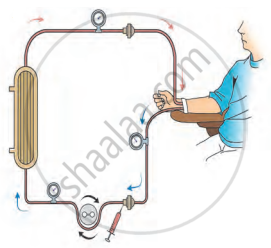
Which of the following is CORRECT with reference to haemodialysis?
Match the abnormal conditions given in Column A with their explanations given in Column B and Choose the correct option
| Column A | Column B |
| A. Glycosuria | i. Accumulation of uric acid in joints |
| B. Renal calculi | ii. Inflammation in glomeruli |
| C. Glomerular nephritis | iii. Mass of crystallised salts within the kidney |
| D. Gout | iv. Presence of glucose in urine |
Which type of kidney stones are formed due to genetic disorders?
Which of the following conditions does not lead to acute renal failure?
Renal calculi is ______.
Oligouria condition in children is when, the urine output is less than ______.
