Advertisements
Advertisements
Questions
Identify chromosomal disorder caused due to non-disjunction of the 21st number of chromosomes and enlist its symptoms.
Identify chromosomal disorder caused due to non-disjunction of 21% chromosome and enlist its characteristics.
Advertisements
Solution
Down syndrome is usually caused by an error in cell division called non-disjunction. Non-disjunction results in an embryo with three copies of chromosome 21 instead of the usual two.
Common Symptoms (Characteristics) of Down syndrome are:
- Mild or moderate mental retardation and poor skeletal development.
- Distinct facial features like small head, ears and mouth.
- Eyes slant up and out with internal epicanthal folds.
RELATED QUESTIONS
Give a detail account of thalassemia.
Identify the INCORRECT statement.
Identify the option that correctly represents the number of chromosomes in Down syndrome.
HbA and HbS alleles of normal and sickle celled RBC are ______.
If a colour-blind man marries a woman who is homozygous for normal colour vision, the probability of their son being colour-blind is ______.
Placed below is a karyotype of a human being.
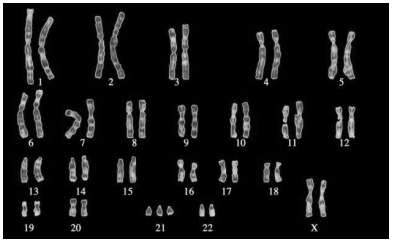
On the basis of this karyotype, which of the following conclusions can be drawn: ______
Read the following and answer from given below:
Turner's syndrome is an example of monosomy. It is formed by the union of an allosome-free egg and a normal 'X' containing sperm or a normal egg and an allosome-free sperm. The individual has 2n = 45 chromosomes (44 + X0) instead of 46. Such individuals are sterile females who have rudimentary ovaries, underdeveloped breasts, small uterus, short stature, webbed neck, and abnormal intelligence. They may not menstruate or ovulate. This disorder can be treated by giving female sex hormones to women from the age of puberty to make them develop breasts and have menstruation. This makes them feel more normal.
Turner's syndrome is an example of ______
Which of the folowing is a correct match?
Give the genotype of Klinefelter’s syndrome.
Which disorder affects haemoglobin production?
