Advertisements
Advertisements
Question
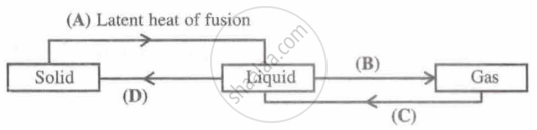
Identify A, B, C and D; first one is done for you.
Advertisements
Solution
(A) Latent heat of fusion: The latent heat of fusion is the amount of energy required to convert a solid to a liquid at atmospheric pressure and melting point.
(B) Latent heat of vaporization: The latent heat of vaporization is the heat energy necessary to convert a liquid to a gas at atmospheric pressure and boiling point.
(C) Latent heat of condensation: The latent heat of condensation is the amount of heat released when a gas is converted to a liquid at atmospheric pressure and boiling point.
(D) Latent heat of solidification: The latent heat of solidification is the heat energy released when a liquid transforms into a solid at atmospheric pressure and melting point.
APPEARS IN
RELATED QUESTIONS
Why do organisms need water?
Why is water essential for life?
What are the main causes of water pollution ? How can it be controlled ?
Give any three important uses of water.
State whether the given statement are true or false. If true, write the reason.
Water availability per person in India is declining.
Give a balanced equation for the following conversion:
Potassium oxide to a strong alkali.
Name a deliquescent substance’.
Around 97% of water available on earth is ______ water.
______ plays a vital role in the evolution and survival of life.
State whether the following statement is True or False. If false, give the correct statement.
51% of the earth’s surface is covered with water
