Advertisements
Advertisements
प्रश्न
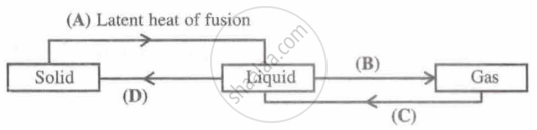
Identify A, B, C and D; first one is done for you.
Advertisements
उत्तर
(A) Latent heat of fusion: The latent heat of fusion is the amount of energy required to convert a solid to a liquid at atmospheric pressure and melting point.
(B) Latent heat of vaporization: The latent heat of vaporization is the heat energy necessary to convert a liquid to a gas at atmospheric pressure and boiling point.
(C) Latent heat of condensation: The latent heat of condensation is the amount of heat released when a gas is converted to a liquid at atmospheric pressure and boiling point.
(D) Latent heat of solidification: The latent heat of solidification is the heat energy released when a liquid transforms into a solid at atmospheric pressure and melting point.
APPEARS IN
संबंधित प्रश्न
State the importance of water cycle in nature.
Give balanced chemical equation for the reaction of water with Sodium .
Give balanced chemical equations to show the reaction between Coke and steam.
Explain why:
Fused CaCl2 or conc. H2SO4 is used in a desiccator.
Complete the statement by filling the blank with the correct word from the option.
Solubility of most solids ___ with rise in temperature.
Explain any two environmental impacts of an ‘oil spill’.
Which are the three states of water?
Which of the following does not show water shortage?
A man travelling on a train threw an empty packet of food on the platform. Do you think this is a proper waste disposal method? Elaborate.
Dissolve two spoons of common salt in half a cup of water. Now if you want to get the salt back, what will you do?
