Advertisements
Advertisements
प्रश्न
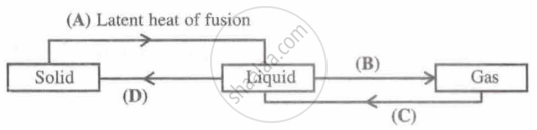
Identify A, B, C and D; first one is done for you.
Advertisements
उत्तर
(A) Latent heat of fusion: The latent heat of fusion is the amount of energy required to convert a solid to a liquid at atmospheric pressure and melting point.
(B) Latent heat of vaporization: The latent heat of vaporization is the heat energy necessary to convert a liquid to a gas at atmospheric pressure and boiling point.
(C) Latent heat of condensation: The latent heat of condensation is the amount of heat released when a gas is converted to a liquid at atmospheric pressure and boiling point.
(D) Latent heat of solidification: The latent heat of solidification is the heat energy released when a liquid transforms into a solid at atmospheric pressure and melting point.
APPEARS IN
संबंधित प्रश्न
Answer the following question:
Why is acid added to water before electrolysis ?
Define
Henry's law
Explain why:
Table salts become sticky on exposure to humid air during the rainy season.
Answer in your own words.
Why is there a shortage of water even though it occupies about 71% of the earth’s surface?
Name a deliquescent substance’.
What is meant by the term ‘oil spill’?
On which of the following day is World Water Day observed?
What is saltwater?
Write any two activities which require less than one bucket of water.
Fill in the blanks selecting words from the following list
snow, rain, clouds, vapour, evaporation, transpiration.
Water, as ______ goes into atmosphere by the processes of ______ and ______ and forms ______, which on condensation fall in the form of ______ and ______.
