Advertisements
Advertisements
Question
I was frightened ______ curious.
Options
and
but
because
so
Advertisements
Solution
I was frightened but curious.
APPEARS IN
RELATED QUESTIONS
A recipe is a list of directions to prepare a dish. The following sentences are not in order for preparing avail. Number them in the correct order.
- Grind some coconut, green chilies, and garlic.
- Cut the vegetable scraps into long strips.
- Wash and clean the mix of vegetable bits.
- Decorate with curry leaves.
- Whip some curd and mix it in.
- Pour some coconut oil on top.
- Avial is ready.
Look up the following words in the dictionary. They may have more than one meaning. List these meanings.
| ground |
||
| survey |
||
| scrap |
||
| sternly | ||
| tempting |
The bridegroom left with the door of his in-laws' house because it was made of ______ and there was no bamboo in his ______.
Why did the geese pretend to be dead?
Why was Robinson afraid when he looked at the bushes and trees?
What did Bhaiya do all day?
Do you have a timetable at school?
How many periods are there for the following subjects and activities in one week?
| English ___, | Hindi ___, | Maths ___, | Science ___, |
| Social Studies ____, | Games ___, | Art ___, | Craft ____, |
| Music ____, | Dance _____, | Any other activity? ____ |
Read the following passage and answer the question that follow.
|
Oliver was a nine-year-old boy. He lived with other homeless boys in an orphanage. He was pale and thin as were the other boys living there. This was because they had to work hard but were never given enough to eat. The owner of the orphanage, Mr. Bumble, was a cruel man and he ill-treated the boys. The boys were always hungry It was true that they were given three meals a day but each meal consisted only of a bowl of watery soup. They were almost starving. So it was decided by them to ask the master for more soup. But who would bell the cat? Finally, the task fell to Oliver. When all the boys had assembled in the cold stone hall for their evening meal, the soup was served. It soon disappeared. The boys whispered to one another and one boy pushed Oliver a little. Oliver, making a brave effort, stood up, walked up to the master with his bowl and spoon in his hand, and said tremblingly, “Please sir, I want some more.” |
1. Why did Oliver live in the orphanage?
2. Who was Mr. Bumble?
3. What meals were the boys given?
4. What did Oliver say to Mr Bumble?
5. The boys were given three meals a day. Then why were they always hungry?
- Because the soup they were given was never enough.
- Because they worked very hard all day long.
- Because the older boys drank up their soup.
6. Find the words from the passage that mean the same as
- very hungry (para 2) ______
- to vanish (para 3) ______
7. ‘All the boys assembled in the cold stone hall.’ Here the word assembled means
- moved away
- collected
- worked together
8. From the word 'assembled' remove the last two letters. Add one letter to make a word which means a time at the school when the whole school gathers.
assembl______
9. Give a suitable title to the passage.
The students have _______ about ‘road safety’.
Match the words in the box with their meanings. You may take the help of a dictionary.
| grizzled | astonished | foothills |
| stroked | familiar |
| near the lower part of a mountain | __________________ |
| with grey hair | __________________ |
| to rub gently | __________________ |
| to be very surprised | __________________ |
| known to you | __________________ |
A Lion
A lion emerged from his lair For a short summer cut to his hair, But the barber he wept, While his customers slept As they waited their turn in the chair.
JOSEPH G. FRANCIS

Did the Sultan enjoy the Barber’s talk? Why do you say so?
Study the words in the first column and see the changes in them in the second column. The words in Column II are the opposites of the words in Column I.
| I | II |
| important | unimportant |
| patient | impatient |
| pleasure | displeasure |
Now write the opposites of the following using un-, im-, dis-.
- believe ______
- shaved ______
- perfect ______
- satisfy ______
- polite ______
- respect ______
- pure ______
- expected ______
- obedient ______
Now use the joining word given in the option to fill in the blank.
Your speech cannot be heard by the audience _______ you use a powerful mike.
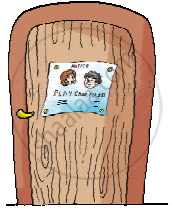
Now look at the pictures and discuss in groups why the following events happened. You may find more than one reason for each of them.
 |
|
 |
A giant bird ______.
A giant reptile _________.
Complete the blank with rhyming word of the following and practice aloud.
Carriage m ______.
Name the place in Manipur where the Ningthou and Leima ruled.
