Advertisements
Advertisements
Question
Hydrogen gas is diatomic whereas inert gases are monoatomic – Explain on the basis of MO theory.
Advertisements
Solution
The molecular orbital electronic configuration of the hydrogen molecule is (σ1s2). The molecular orbital energy level diagram of the H2 molecule is given in

Here, N2 = 2, Na = 0
Bond order = `("N"_"b" - "N"_"a")/2`
`= (2 - 0)/2` = 1
He2: σ1s2 σ1s*2
The molecular orbital energy level diagram of He2 (hypothetical) is given in
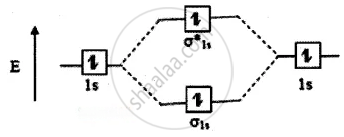
Here, Nb = 2 and Na = 2
Bond order = `("N"_"b" - "N"_"a")/2`
`(2 - 2)/2` = 0
As the bond order for He2 comes out to form between two hydrogen atoms. But as the bond order of helium is zero, there is no bond between helium atoms and hence it is monoatomic.
Result:
As the bond order of the H2 molecule is one, it is diatomic and a single bond is formed between two hydrogen atoms. But as the bond order of helium is zero, there is no bond between helium atoms and hence it is monoatomic.
APPEARS IN
RELATED QUESTIONS
Draw an orbital diagram of Hydrogen fluoride molecule
Give the total number of electrons around sulfur (S) in SF6 compound.
Draw the M.O diagram for oxygen molecule calculate its bond order and show that O2 is paramagnetic.
4p, 4d, 5s and 5p orbitals are arranged in the order of decreasing energy. The CORRECT option is:
Which one of the following sets CORRECTLY represents the increase in the paramagnetic property of the ions?
Among the following MOs, the highest energy MO that is occupied by electrons in case of N2 molecule is ______.
H2 molecule is more stable than Li2 molecule, because ______.
The electronic configuration of Be2 molecule according MOT is ______.
Bonding in which of the following diatomic molecule(s) become(s) stronger, on the basis of MO Theory, by removal of an electron?
(A) NO
(B) N2
(C) O2
(D) C2
(E) B2
Choose the most appropriate answer from the options given below:
The correct statement with regard to \[\ce{H^+_2}\] and \[\ce{H^-_2}\] is:
