Advertisements
Advertisements
Question
How will you show that hychloric acid contains both hydrogen and chlorine (other than by electrolysis) ?
Advertisements
Solution
On reaction with metals, hydrochloric acid forms respective chlorides and liberates hydrogen.
\[\ce{Zn + 2HCl -> ZnCl2 + H2 ^}\]
On reaction with oxidizing agents, hydrochloric acid forms respective salts water and pungent smelling, greenish yellow chlorine gas.
\[\ce{\underset{\text{Manganese
dioxide}}{MnO2} + 4HCI -> \underset{\text{Manganese chloride}}{MnCl2(aq)} +2H2O +C12 ^}\]
APPEARS IN
RELATED QUESTIONS
When dilute HCl is added to a salt Q, a brisk effervescence is produced and the gas turns lime water milky.
When NH4OH solution is added to the above mixture (after adding dilute HCl), it produces a white precipitate which is soluble in excess NH4OH solution.
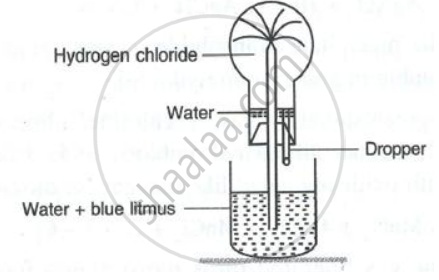
The aim of the Fountain experiment is to prove that ______.
Study the figure given below and answer the questions which follow:
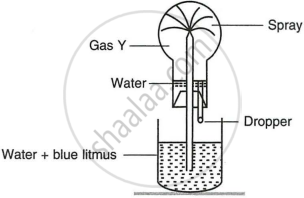
- Identify the gas Y.
- What property of gas Y does this experiment demonstrate?
- Name another gas which has the same property and can be demonstrated through this experiment.
Name :
Two colourless gases which when mixed produce a white solid.
How is the gas collected and why?
Choose the correct answer from the options given below: HCl gas can be prepared by direct combination of hydrogen and chlorine gas in presence of
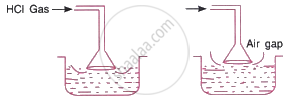
Hydrogen chloride gas is very soluble in water. It is dissolved in water to prepare hydrochloric acid by using an anti-suction device, as shown in the diagram. Very briefly explain, how this device prevents the suction of water into the flask, in which hydrogen chloride gas is produced.
Dilute hydrochloric acid is added in turn to a mixture of iron and sulphur and to the compound formed between iron and sulphur. Name the gas formed in each case.
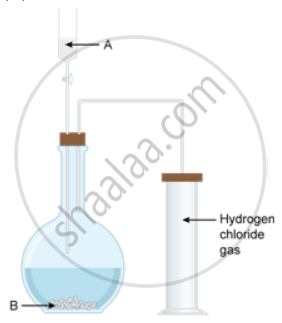
The diagram shows an apparatus for the laboratory preparation of hydrogen chloride.
(i) Identify A and B
(ii) Write the equation for the reaction
(iii) How would you check whether or not the gas jar is filled with hydrogen chloride?
(iv) What does the method of collection tell you about the density of hydrogen chloride.
- Name the experiment illustrated below.
- State the colour of the water that has entered the round-bottomed flask.