Advertisements
Advertisements
Questions
How much heat energy is necessary to raise the temperature of 5 kg of water from 20°C to 100°C?
How much heat energy is necessary to raise the temperature of 5 kg of water from 20°C to 100°C? [c = 1 kcal/kg°C]
Advertisements
Solution
Given: Mass (m) = 5 kg, specific heat of water (c) = 1 kcal/kg °C
Change in temperature (ΔT) = 100 − 20
= 80°C
According to the principle of heat exchange,
Energy supplied to water = Energy gained by water
= Mass of water × specific heat of water × rise in the temperature of water
Q = mc ΔT
Q = 5 × 1 × 80
= 400 kcal
The heat energy necessary to raise the temperature of the water is 400 kcal.
APPEARS IN
RELATED QUESTIONS
In an experiment on the specific heat of a metal, a 0.20 kg block of the metal at 150 °C is dropped in a copper calorimeter (of water equivalent 0.025 kg) containing 150 cm3 of water at 27 °C. The final temperature is 40 °C. Compute the specific heat of the metal. If heat losses to the surroundings are not negligible, is your answer greater or smaller than the actual value for the specific heat of the metal?
You have a choice of three metals A, B, and C, of specific heat capacities 900 Jkg-1 °C-1, 380 Jkg-1 °C-1 and 460 Jkg-1 °C-1 respectively, to make a calorimeter. Which material will you select? Justify your answer.
State two factors upon which the heat absorbed by a body depends
Water in lakes and ponds do not freeze at once in cold countries. Give a reason is support of your answer.
What is carbon tax?
What is the specific heat capacity of boiling water?
What is the unit of heat capacity in CGS system?
(b) 2000 J of heat energy is required to raise the temperature of 4 kg of a
metal by 3°c. Which expression gives the specific heat capacity of the metal?
Write two advantages of high specific heat capacity of water.
Explain, why do sandy soils, get heated up quickly as compared to wet soils?
Is it possible to condense the water formed, back to ice by adding ice at 0°C. Explain with reason.
The specific heat capacity of water is 1 cal/g °C.
Define specific heat capacity.
When a uniform rod is heated, which of the following quantity of the rod will increase
Explain why the specific heat capacity at constant pressure is greater than the specific heat capacity at constant volume.
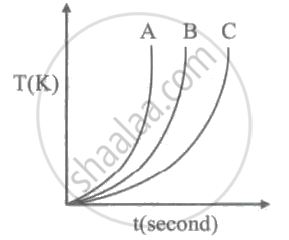
Which of the following substances (A, B and C) has the highest specific beat?
Two uniform brass rods A and B of length land 2l and radii 2r and r respectively are heated to the same temperature. The ratio of the increase in the volume ofB to that of A is ____________.
Two metals A and B have specific heat capacities in the ratio 2:3. If they are supplied same amount of heat then
If specific heat capacity of metal A is 0.26 Jg-1 0C-1 then calculate the specific heat capacity of metal B.
Find the odd one out:
