Advertisements
Advertisements
Question
How does earthing prevent electrical shock?
Advertisements
Solution
Local earthing provides us safety from electric shocking in the case of short circuiting. When excessive current flows through the live wire, it will pass to the earth through the earth wire. In the absence of local earthing, it may causes fire due to over heating of the live wire.
In the case of an electronic appliance, if its outer metallic body is earthed and by chance, if it happens to touch live wire, then metallic casing acquires the potential of the live wire and so any person touching it is likely to get a total shock. But if earthed, a heavy current flows and the fuse connected to the appliances blows off. Thus the person touching it does not get any shock.
RELATED QUESTIONS
An electric bulb is rated 220 V and 100 W. When it is operated on 110 V, the power consumed will be ______.
If a bulb of 60W is connected across a source of 220V, find the current drawn by it.
The coil of an electric bulb takes 40 watts to start glowing. If more than 40 W are supplied, 60% of the extra power is converted into light and the remaining into heat. The bulb consumes 100 W at 220 V. Find the percentage drop in the light intensity at a point if the supply voltage changes from 220 V to 200 V.
The diagram below shows a magnetic kept just below the conductor AB which is kept in North South direction.
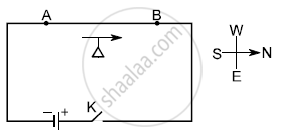
(i) In which direction will the needle deflect when the key is closed ?
(ii) Why is the deflection produced ?
(iii) What will be the change in the deflection if the magnetic needle is taken just above the conductor AB ?
(iv) Name one device which works on this principle.
An electric iron rated 750 W is operated for 2 hours/day. How much energy is consumed by the electric iron for 30 days?
What is electric power? State and define its S.I. unit.
Name three main characteristics of an heating element.
Why is heating element wound on a long porcelain rod in a room heater.
You are required to connect a bulb, a fan and a socket outlet to the mains in one set A and an air-conditioner and a refrigerator to the mains in other set B. Will you recommend the wire of same thickness and same insulation in both? explain your answer.
An electric bulb is rated as 100W – 250V. What information does it convey? Calculate the resistance of its filament while glowing.
