Advertisements
Advertisements
Question
With reference to the diagram shown below calculate:

(i) The equivalent resistance between P and Q.
(ii) The reading of ammeter.
(iii) The electrical power between P and Q.
Advertisements
Solution
(i) `1/"R" = 1/4 + 1/6 = (3 + 2)/12 = 5/12`
So, equivalent resistances
`= 12/5 = 2.4 Omega`
(ii) Here, R = 2.4 Ω
E = 2 × 2 = 4 V
From E = IR
I = `"E"/"R"` or I = `4/2.4 = 1.66` A
(iii) Power between P and Q
= I2R
= (1.66)2 × (2.4) = 6.66 watts
APPEARS IN
RELATED QUESTIONS
An electric bulb is rated 220 V and 100 W. When it is operated on 110 V, the power consumed will be ______.
Which uses more energy: a 250 W TV set in 1 hour or a 1200 W toaster in 10 minutes?
A current of 0.2 A flows through a wire whose ends are at a potential difference of 15 V.
calculate:
(i) the resistance of the wire and
(ii) the heat energy produced in 1 minute.
An immersion heater rated 1000 W, 220 V is used to heat 0.01 m3 of water. Assuming that the power is supplied at 220 V and 60% of the power supplied is used to heat the water, how long will it take to increase the temperature of the water from 15°C to 40°C?
Point out two main disadvantages of ‘Tree System’.
An electric iron is rated at 230 V, 750 W. What is its resistance? What maximum current can be passed through it?
An Electric bulb is marked 100 W, 230 V. What how long would this lamp take to consume one unit of electricity?
A battery of e.m.f. 12V and internal resistance 1.6 Ω is connected to two resistors of 4Ω and 6Ω connected in parallel. Calculate:
(i) the current drawn from the battery,
(ii) the power dissipated in each resistor,
(ii)the total power supplied by the battery.
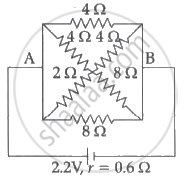
In the given figure, the emf of the cell is 2.2 V, and if internal resistance is 0.6 Ω. Calculate the power dissipated in the whole circuit.
Two heaters A and B have power rating of 1 kW and 2 kW, respectively. Those two are first connected in series and then in parallel to a fixed power source. The ratio of power outputs for these two cases is ______
