Advertisements
Advertisements
प्रश्न
How does earthing prevent electrical shock?
Advertisements
उत्तर
Local earthing provides us safety from electric shocking in the case of short circuiting. When excessive current flows through the live wire, it will pass to the earth through the earth wire. In the absence of local earthing, it may causes fire due to over heating of the live wire.
In the case of an electronic appliance, if its outer metallic body is earthed and by chance, if it happens to touch live wire, then metallic casing acquires the potential of the live wire and so any person touching it is likely to get a total shock. But if earthed, a heavy current flows and the fuse connected to the appliances blows off. Thus the person touching it does not get any shock.
संबंधित प्रश्न
State two factors on which the electrical energy consumed by an electrical appliance depends.
An electric bulb is rated ‘100 W, 250 V’. What information does this convey?
Tick(✓) the correct choice in the following:
In the circuit shown in the following fig, the e.m.f. of the cell is 4 volts, the current
flowing through the resistor is
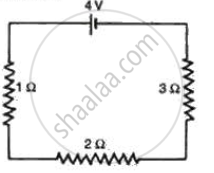
Define electric power. An electrical device of resistance R is connected across a source of voltage V and draws a current I. Derive an expression for power in terms of current and resistance.
Point out two main disadvantages of ‘Tree System’.
The following table gives the electrical appliances used, their power and the average time for which they are used each day in a home. Estimate the monthly electricity bill if the rate is 60 paise per unit.
| Sr.no. | Name | Nos. | Power rating | Time/day |
| 1 | Bulb | 4 | 100 W | 7.5 hr |
| 2 | Fans | 2 | 50 W | 10 hr |
| 3 | T.V. | 1 | 100 W | 2 hr |
| 4 | Iron | 1 | 500 W | 1 hr |
| 5 | Electric stove | 1 | 750 W | 2 hr |
1 kWh is equal to:
What is the commercial unit of electrical energy? Represent it in terms of joules.
A room has AC run for 5 hours a day at a voltage of 220V. The wiring of the room consists of Cu of 1 mm radius and a length of 10 m. Power consumption per day is 10 commercial units. What fraction of it goes in the joule heating in wires? What would happen if the wiring is made of aluminium of the same dimensions?
`[ρ_(Cu) = 1.7 xx 10_(Ωm)^-8, ρ_(Al) = 2.7 xx 10^-8 Ωm]`
