Advertisements
Advertisements
प्रश्न
I ampere of current is passed through a resistor of resistance R ohm for time t second. Obtain expression for
(i) the electrical energy, and
(ii) the electrical power spent.
Advertisements
उत्तर
The potential difference across the resistor V = IR volt
Charge passed in resistor Q = It coulomb
(i) Work was done (or the electrical energy spend) in passing charge Q coulomb through the resistor at potential difference V volt = QV joule
= (It) × (IR) = I2Rt joule.
(ii) Electrical power spent = `"Energy"/"Time" = ("I"^2"Rt")/"t"` = I2R watt.
संबंधित प्रश्न
Define watt-hour. How many joules are equal to 1 watt-hour?
Electrical power p is given by the expression P = (Q × V) ÷ time. Express the power P in terms of current and resistance explaining the meaning of symbols used there in.
Name the physical quality which is measured in
(i) Kw (ii) kWh
A current passes through a resistor. Let K1 and K2 represent the average kinetic energy of the conduction electrons and the metal ions, respectively.
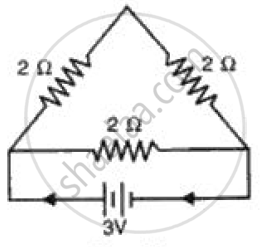
What is the current I in the given circuit (Fig. )?
Give two precautious that you would take while putting off an electric switch.
Three 250 W heaters are connected in parallel to a 100 V supply, Calculate the resistance of each heater.
What is the commercial unit of electrical energy?
Two heaters A and B have power rating of 1 kW and 2 kW, respectively. Those two are first connected in series and then in parallel to a fixed power source. The ratio of power outputs for these two cases is ______
