Advertisements
Advertisements
Question
I ampere of current is passed through a resistor of resistance R ohm for time t second. Obtain expression for
(i) the electrical energy, and
(ii) the electrical power spent.
Advertisements
Solution
The potential difference across the resistor V = IR volt
Charge passed in resistor Q = It coulomb
(i) Work was done (or the electrical energy spend) in passing charge Q coulomb through the resistor at potential difference V volt = QV joule
= (It) × (IR) = I2Rt joule.
(ii) Electrical power spent = `"Energy"/"Time" = ("I"^2"Rt")/"t"` = I2R watt.
RELATED QUESTIONS
What is the maximum power in kilowatts of the appliance that can be connected safely to a 13 A ; 230 V mains socket?
Which of the following is likely to be the correct wattage for an electric iron used in our homes?
(a) 60 W
(b) 250 W
(c) 850 W
(d) 2000 W
Fig . shows the essent ial features of a battery operated bell. The hammer strikes the gong when the swi tch is closed . State and explain the effect of using the following material successively to form the core.
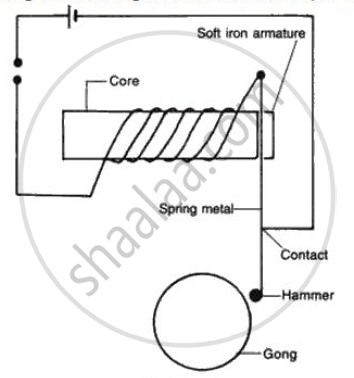
(a) Plastic
(b) Steel
(c) Copper
Water in an electric kettle connected to a 220 V supply took 5 minutes to reach its boiling point. How long will it take if the supply voltage falls to 200 V?
In an electric radiator or room heater, state with reason, why the porcelain tube wound with a nichrome wire is placed between the pole and principal focus of the parabolic concave reflector.
State two advantages of filling an inert gas in an evacuated electric filament lamp.
A device is used to transform 12 V a.c. to 200 V a.c. What is the name of this device? Name the principle on which it works.
Which material is the calorimeter commonly made of? Give one reason for using this material.
1 kWh = ____________
An overhead tank of capacity 10 k litre is kept at the top of building 15 m high. Water falls in tank with speed 5`sqrt2` m/s. Water level is at a depth 5 m below ground. The tank is to be filled in `1/2` hr. If efficiency of pump is 67.5% electric power used is ______ W.
