Advertisements
Advertisements
Question
An electric lamp A of 40 W and another electric lamp B of 100 W are connected to 220 V supply. Calculate the ratio of their filament resistances?
Advertisements
Solution
P = `"V.I" = "V.V"/"R"`
`40 = (220)^2/"R"_"A"`
RA = `(220 xx 220)/40`
RA = 110 × 11
P = `"V"^2/"R"`
`100 = (220)^2/"R"_"B"`
`"R"_"B" = (220 xx 220)/100`
RB= 22 × 22
`"R"_"A"/"R"_"B" = (110 xx 11)/(22 xx 22) = 5/2 = 5 : 2`
`"R"_"A"/"R"_"B" = 5: 2`
RELATED QUESTIONS
Two lamps, one rated 100 W at 220 V, and the other 60 W at 220 V, are connected in parallel to electric mains supply. What current is drawn from the line if the supply voltage is 220 V?
State and define the household unit of electricity.
An electric bulb is rated at 220 V, 100 W. (a) what is its resistance? (b) what safe current can be passed through it?
What is the current in the circuit shown (Fig. )
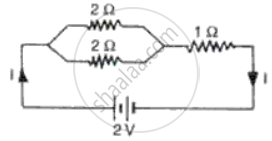
Tick(✓) the correct choice in the following:
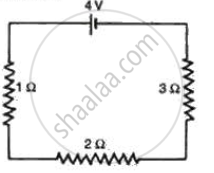
In the circuit shown in the following fig, the e.m.f. of the cell is 4 volts, the current
flowing through the resistor is
Two lamps are rated 220V, 50W and the other rated 220V, 100W are connected in series with the mains of 220 V. Explain, why the 50W lamp glows more?
An electric heater is rated 220 V, 550 W. Calculate the electrical energy consumed in 3 hours?
How is the amount of heat produced calculated due to the passage of current in a metallic conductor? Derive an expression for it.
Out of the three fuses with current ratings 5A, 10A, 15A, which one is to be connected in a geyser circuit marked 3 kW, 220V? Give reason for your answer.
A. bulb is rated at 100W, 250V and another one at 60W, 250V. What is the current flowing in the circuit if the two bulbs are put in series across a 220 V mains supply?
