Advertisements
Advertisements
Question

Given below is a picture of a beautiful scene you saw on your trip to Varanasi, Uttar Pradesh. Write an email to your friend Harsh, in Bangalore, describing the scene. To help you write your e-mail, firs match the determiners in the box with items from the picture. (X indicates that the word does not require a determiner.) Apart from the determiners given in the box, you can also use other suitable determiners.
two, three (etc), an, a, the, several, many, very little, every, each, X
.......... mango groves
............. ghats
............. riverganga
...............prayer flags
.............. ascetics
............ boats
............. tourists
............ temples
............. devotees
............ team of security officials
.............. sand
Advertisements
Solution
Mony mango groves
Tow/Three/Several ghats
The riverganga
Several/ many prayer flags
Several/ many ascetics
Tow/Three/Several boats
Several/ many tourists
Several/ many temples
Many devotees
A team of security officials
Very little sand
Date : 18th July, 20 – –
From : [email protected]
Sub : Trip to Varanasi, Uttar Pradesh
To : harsh 10@gmail .com
Dear Harsh
I hope everything is fine at your end. In this e-mail I am describing my visit to Varanasi, Uttar Pradesh.
I visited this religious centre last week with my parents. The place, the ghats at the river Ganga have a religious fervour. There flutter a lot of prayer flags. Several ghats have long steps where pilgrims bathe or dip in the holy river. The river Ganga flows majestically here touching the several mango groves and buildings. There is a big crowd of ascetics who sit scattered here and there on the ghats. They add a religious aura to the place. At the same time, hundreds of thousands devotees throng these ghats to dip in the Ganga when there are religious festivals like Kumbh. There is then a full team of security officials supervising the place and other things.
The place has a strange charm of its own. Even a non-believer can be influenced by the faith of the people and the religious fervour of the place. Several foreign tourists can be spotted wearing ochre turbans and dresses. The scene at Varanasi, thus, is a thing to memorize. It is always pleasure-giving. Do find time to visit it.
With best wishes
Regards : Yours sincerely
Raju
APPEARS IN
RELATED QUESTIONS
In this unit you will use the words which help to identify things – to say whether they are known or unknown to the listener, which one(s) the speaker is talking about, whether the speaker is thinking of specific examples or talking in general. You will also work with words which say ‘how much’ or ‘how many’.
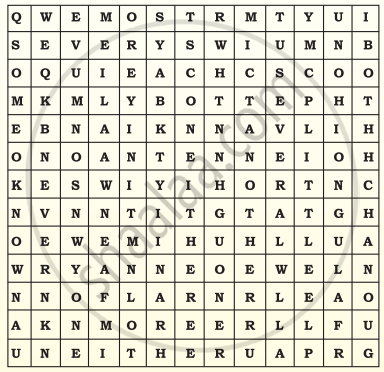
There are twenty determiners in the grid given below. Encircle these determiners.
Articles
1. The building that I visited today is a museum.
2. A building in which antiques are kept is called a museum.
Working in pair, decide which of the following items in italics is definite (or specific) and which is indefinite (or non-specific).
Then complete the following sentence using appropriate articles.
- Australia, ................ country in the southern Hemisphere, has produced some world-class sportspersons.
Working in pair, decide which of the following items in italics is definite (or specific) and which is indefinite (or non-specific).
Then complete the following sentence using appropriate articles.
- ................... girl who lives at the corner of our street has been selected for the
civil services.
Working in pair, decide which of the following items in italics is definite (or specific) and which is indefinite (or non-specific).
Then complete the following sentence using appropriate articles.
- .............. Punjab, .......... important state of North India, has five rivers flowing through it.
Working in pair, decide which of the following items in italics is definite (or specific) and which is indefinite (or non-specific).
Then complete the following sentence using appropriate articles.
- 1950 is ___ year in which India became a republic.
Determiners with countable and uncountable nouns
Now get into groups of four, compare your answers, and decide which of
the determiners can be used with
..................................... countable nouns only
.................................... uncountable nouns only
........................................... both countable and uncountable nouns
Fill in the table below as you do this activity
| Countable (C) | Uncountable (U) | Both (C) and (U) |
| a pen | some water | some pens / some water |
Choose the appropriate option from the box to complete the given sentence.
l had left _____I [ the/ my] green shirt on the bed, but l can't find it now.
Choose the appropriate option from the box to complete the given sentence.
He drove with ______Care [ much / little ] care and hence was fined by the Traffic Police .
Choose the appropriate option from the box to complete the given sentence.
_______ [ little / a little ] milk is required for a cup of tea.
Choose the appropriate option from the box to complete the given sentence.
______[ few/ some ] of the mango trees in their garden bear fruit twice a Year .
Choose the appropriate option from the box to complete the given sentences.
_________[ any / each ]student of this class is a scholar badge holder.
From the following sentence, underline the Nouns and encircle their Determiners that specify the nouns in a noun phrase.
(articles/possessive pronouns/demonstratives or quantifiers)
Over the years, Hawking has written 15 books.
From the following sentence, underline the Nouns and encircle their Determiners that specify the nouns in a noun phrase.
(articles/possessive pronouns/demonstratives or quantifiers)
That dream made him realize it.
Determiners are words that modify a noun or noun phrase and occur before them in a sentence. Determiners provide a context to the noun they precede.
They may be:
- Articles - a, an, the
- Demonstratives - this, that, these, those, which etc.
- Possessives - my, your, our, their, his, her etc. my friend’s, her mother’s etc.
- Quantifiers - few, many, much, more, every, each, some etc.
- Numerals - one, four, hundred, first, fourth, hundredth
