Advertisements
Advertisements
Question
Determiners with countable and uncountable nouns
Add a suitable noun to each of the following determiners in the box below.
| a............ both............. few................. much.............. all............... each............ little ............ neither................ an.............. either.............. many ............... no............. another............... enough .............. more .............. any .............. every........... most........... several............... one.............. some............. two(etc).............. a lot of ............. |
Advertisements
Solution
a girl both the boys few boys much smoke
all boys each girl little milk neither boy
an elephant either tree many sheep no boy
another girl enough sugar more water any work
every cadet most money several boys one boy
some children two(etc) fans a lot of noise
APPEARS IN
RELATED QUESTIONS
In this unit you will use the words which help to identify things – to say whether they are known or unknown to the listener, which one(s) the speaker is talking about, whether the speaker is thinking of specific examples or talking in general. You will also work with words which say ‘how much’ or ‘how many’.
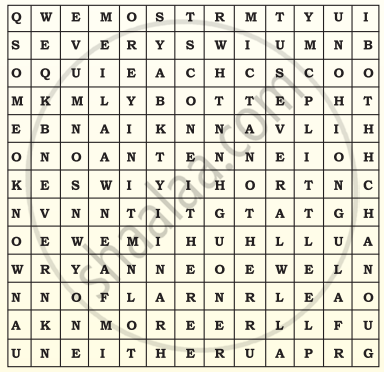
There are twenty determiners in the grid given below. Encircle these determiners.
Working in pair, decide which of the following items in italics is definite (or specific) and which is indefinite (or non-specific).
Then complete the following sentence using appropriate articles.
- Bangkok is ___ capital of Thailand.
Working in pair, decide which of the following items in italics is definite (or specific) and which is indefinite (or non-specific).
Then complete the following sentence using appropriate articles.
- Australia, ................ country in the southern Hemisphere, has produced some world-class sportspersons.
Working in pair, decide which of the following items in italics is definite (or specific) and which is indefinite (or non-specific).
Then complete the following sentence using appropriate articles.
- ___ fruit seller does not earn much during the rainy season.
Working in pair, decide which of the following items in italics is definite (or specific) and which is indefinite (or non-specific).
Then complete the following sentence using appropriate articles.
- ................... girl who lives at the corner of our street has been selected for the
civil services.
Working in pair, decide which of the following items in italics is definite (or specific) and which is indefinite (or non-specific).
Then complete the following sentence using appropriate articles.
- The Amazon is considered to be ___ largest river in the world, in terms of volume of water.
In groups of four, read the following description from a geography book, and underline the geographical names.
The Himalayas, the highest mountain range in the world, protect India from the cold winds blowing from central Asia and the People's Republic of China. Mount Everest, the highest mountain peak of the world belongs to this range and is situated in Nepal. To the south of the Himalayas, the great northern plains extend between the mouth of the rivers Indus and the Ganga. The Indus, the Ganga and the Brahmaputra start in the Himalayas .The Indus starts in Tibet near Mansarovar Lake. The Ganga rises in the Himalayas and the Brahmaputra, also known as Tsang Po, starts in Tibet. The Ganga and the Brahmaputrajoin together before flowing into the Bay of Bengal. Between the fertile Indus and Ganga plains are the Aravalli Hills and the Thar Desert.
Now discuss within your groups how the article is used (or not used) before geographical terms, and complete the following table:
| Names | Category | Use of the | Conclusion | Other examples |
| Himalyas | Mountain range | The' is used before names of mountain ranges |
The Alps The Andes |
|
| Mount Everest | ||||
| Cities | Pune, Delhi | |||
| India Nepal |
||||
|
People's Republic of China |
A country whose name includes words like republic, union etc. | |||
| Rivers | ||||
| Dal lake | ||||
| Deserts |
Choose the appropriate option from the box to complete the given sentence.
1 have been to ______ [a/ the ] doctor, whose name appeared in the New York Times.
Choose the appropriate option from the box to complete the given sentence.
l had left _____I [ the/ my] green shirt on the bed, but l can't find it now.
Choose the appropriate option from the box to complete the given sentence.
________[ India/ lndia's] cultural diversity attracts tourists from all over the world.
Choose the appropriate option from the box to complete the given sentence.
The ______[ many / three ] monkeys that escaped from the Delhi zoo were found eating bananas in a fruit shop.
Choose the appropriate option from the box to complete the given sentence.
I spent _______[ the little / a little ] money I had.
From the following sentence, underline the Nouns and encircle their Determiners that specify the nouns in a noun phrase.
(articles/possessive pronouns/demonstratives or quantifiers)
He lost his voice for good.
From the following sentence, underline the Nouns and encircle their Determiners that specify the nouns in a noun phrase.
(articles/possessive pronouns/demonstratives or quantifiers)
A few events prevented him from despondency.
From the following sentence, underline the Nouns and encircle their Determiners that specify the nouns in a noun phrase.
(articles/possessive pronouns/demonstratives or quantifiers)
That dream made him realize it.
Determiners are words that modify a noun or noun phrase and occur before them in a sentence. Determiners provide a context to the noun they precede.
They may be:
- Articles - a, an, the
- Demonstratives - this, that, these, those, which etc.
- Possessives - my, your, our, their, his, her etc. my friend’s, her mother’s etc.
- Quantifiers - few, many, much, more, every, each, some etc.
- Numerals - one, four, hundred, first, fourth, hundredth
Underline only Determiners in the following.
My brother bought a few magazines.
