Advertisements
Advertisements
Question
Given below is the outline of the male reproductive system.
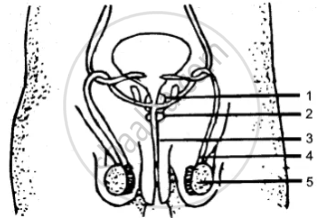
(i) Name the parts labeled 1 to 5.
(ii) State the functions of the parts labeled 1 and 4.
(iii) Name the cells of part 5 that produce testosterone.
(iv) Why is structure 5 present outside the body in the scrotal sacs?
(v) What is semen?
Advertisements
Solution
(i)
1. Prostate gland.
2. Cowper’s gland.
3. Urethra.
4. Sperm duct.
5. Testis.
(ii)
1. Prostate gland: it secretes an alkaline matter which neutralizes the acidity of urethra.
4. Sperm duct: It carries sperms from epididymis to the urethra.
(iii) Cells of Leydig.
(iv) The testis is located in the scrotal sacs so that they can maintain a low temperature than the body cavity. This low temperature is necessary for the maturation of sperms.
(v) Semen is the mixture of sperm and secretions of the seminal vesicles, prostate gland, and Cowper's gland.
RELATED QUESTIONS
Given on the right is a diagram which represents the reproductive organs of a man:
(i) Write the names of the parts numbered 1 to 16.
(ii) Give two functions of the part 6.
(iii) Name three components of the fluid which may be found in the tube labeled 2.
(iv) What is the main function of the part labelled 3?

Mention, if the following statement is True or False. If false rewrite the wrong statement in its correct form:
Cowper’s gland opens into the urethra.
Write the functional activity of the following structure:
Seminiferous tubules
How is the semen produced?
Cowper's gland is homologous in function to ______
In the process of spermatogenesis, first maturation division is called ______.
Which of the following hormone maintains the function of male sex accessory gland and ducts?
The primary sex organ of a human male is ______.
Along the path of the vas-deferens the secretions of which gland provide nutrition to the sperms?
What is the significance of epididymis in male fertility?
