Advertisements
Advertisements
Question
What is the significance of epididymis in male fertility?
Advertisements
Solution
The epididymis helps the sperm in attaining maturity, acquiring increased motility and fertilising capacity. It also stroes sperms for a short period before entering the vasa deferns. The epididymis shows peristatic and segmenting controctions at intervals to push the sperm away from the testis.
APPEARS IN
RELATED QUESTIONS
Write two major functions of testis.
Identify True/False statement. Correct false statement to make it true.
Spermatozoa get nutrition from Sertoli cells.
Multiple choice question. Tick (✓) the correct choice:
Testis are present in a sac called
- scrotum
- oviduct
- epididymis
- none of the above
Differentiate between the following pair:
Bulbo-urethral gland and prostate gland
Explain the Term Penis.
Explain the term Vasectomy.
Mention, if the following statement is True or False. If false rewrite the wrong statement in its correct form:
Cowper’s gland opens into the urethra.
Write the functional activity of the following structure:
Seminiferous tubules
Identify the labels (a, b, c, and d) in the given diagram of the male reproductive system.
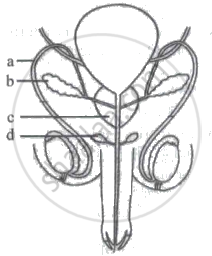
Seminal plasma, the fluid part of semen, is contributed by.
- Seminal vesicle
- Prostate
- Urethra
- Bulbourethral gland
Prostate glands are located below ______.
Cell at the end of first meiotic division male sperm differentiates into ______.
Explain the function of the following structure in the human male reproductive system.
Scrotum
Explain the function of the following structure in the human male reproductive system.
Leydig cells
Sketch and label Human Male Reproductive System.
Assertion (A): Testes in human males are located outside the abdominal cavity in scrotum.
Reason (R): Scrotum provides a lower temperature than the normal body temperature for sperm formation.
Statement I: Vas deferens receives a duct from seminal vesicle and opens into urethra as the ejaculatory duct.
Statement II: The cavity of the cervix is called cervical canal which along with vagina forms birth canal.
In the light of the above statements, choose the correct answer from the options given below:
The scrotum maintains a temperature how much lower than normal body temperature?
The seminal vesicles are paired glands located at which position relative to the urinary bladder?
