Advertisements
Advertisements
Question
Give two reasons why the efficiency of a single movable pulley system is not 100%.
Advertisements
Solution
The efficiency of a single movable pulley system is not 100% this is because
- The friction of the pulley bearing is not zero.
- The weight of the pulley and string is not zero.
APPEARS IN
RELATED QUESTIONS
The pulley system has drawn lifts a load of 150 N when an effort of 60 N is applied. Find its mechanical advantage.
Explain the working of a gear system.
Differentiate between a single fixed pulley and a single movable pulley.
What is the use of a fixed pulley?
What is a block and tackle system of pulleys?
Fig shown a block and tackles system of pulleys used to lift a load.
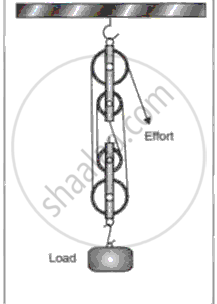
(i) How many strands of tackle are supporting the load?
(ii) Draw arrows to represent tension in each stand.
(iii) What is the mechanical advantage of the system?
(iv) When load is pulled up by a distance 1 m how far does the effort end move?
What is a block and tackle system of pulleys?
(a) Fig represents an incomplete diagram of a simple string pulley system. Copy this diagram on a new page and complete it and mark where the effort must be applied to lift the load.
(b) What is the velocity ratio of this system?
(c) If the pulley system is 80% efficient and the load is 720 N, then
(i) What effort must be applied to lift the load?
(ii) What work must be done must be done in lifting the load through a distance of 2 m using this machine?
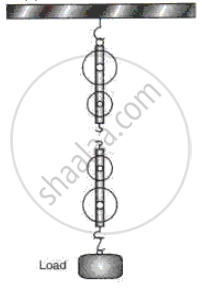
In the alongside the figure of two pulleys shown a system in which one pulley is fixed and the other is movable. What is the velocity ratio of the system?
An effort of 600 N is needed to lift a weight of 1000 N. What are the mechanical advantage and efficiency of the pulley system?
