Advertisements
Advertisements
Question
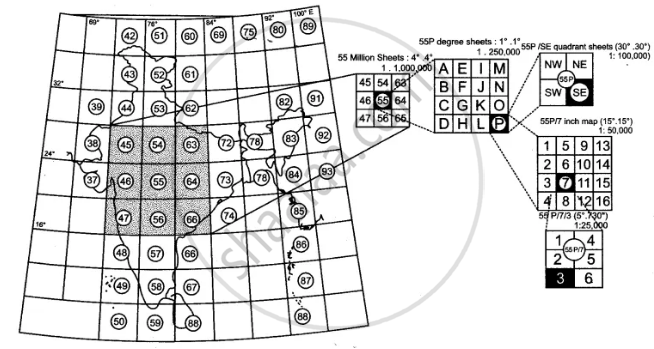
Give a summary of dimension and scale of topographical maps.
Advertisements
Solution
RELATED QUESTIONS
Name the state that produces the largest amount of limestone.
Name two natural features in 0527.
Give the six figure grid reference of lined well near Chekhla.
What type of rainfall is experienced in the region shown in the map extract? Justify your answer giving one reason.
Calculate the distance in kilometres along the cart track between Chitrasani (999747) and Pirojpura (978753).
What is a Flat land?
The area is measured by grid square method?
Which colours are used on toposheets? What is their significance?
Study the extract of the Survey of India Map Sheet No. 45 D/7 (A – B) and answer the following questions:
(a) (i) What does the abbreviation R. F., stand for?
(ii) What does 20r (grid sq. 8295) mean.
(iii) What does V near Shergadh village in the south-east corner mean.
(b)
(i) What type of relief do you observe in north-west of the map (West Panswala)?
(ii) Why is the land shown in white shade not put to cultivation?
(c)
(i) What seems to be the importance of village Jegol in grid sq. 8590 in the south?
(ii) Find out the length of the joint stream of rivers Sipu, Varka and Hanva.
(d) What type of relief feature is found close to Varkanala and Hanvanala near Gangudra in the centre of the area?
(e) Give four figure grid reference of a well marked meander of Varkanala and Sipu river.
(f)
(i) What does the black line marked 24°30′ in the north denote.
(ii) What is the meaning of 72°20′ north-south black line in the western part of the map?
(iii) What do the figures 280, 300, 500 etc., written in brown on east margin of the map indicate.
(g)
(i) Point out two man-made features on the map.
(ii) What is the direction of the river Sipu 83 C 86 grid lines?
(iii) What is the grid reference (four figures) of the lime kiln located near Rampura village in the north-west?
Study the extract of the Survey of India Map Sheet No. 45 D/7 (A and B) and answer the following questions.
(a) Give the six figure grid reference of
(i) ∆ 277 (→) (ii) Lime kiln near Rampura (→) (iii) Stony waste (→).
(b) (i) What does the blue line in the Sipu river indicate?
(ii) In which village do you see the nodal function 7 What do you mean by this?
(c) (i) What does the black lines along the streams in the grid square 9199 indicate?
(ii) How are these features formed?
(iii) What type of region is shown in grid square 8696?
(d) Give the six-figure grid reference of the following:
(i) Lime Kiln near village Panswala.
(ii) Well with water near village Gonodara.
(iii) Dry tank near village Mohudi Moti.
(e) (i) What is the direction of the flow of Sipu river?
(ii) State why does it flow in this particular direction?
(f) Mention three natural features in the grid square 8998.
(g)
(i) What is the meaning of the term open scrub printed on the map.
(ii) How do you get an idea of the general nature of the slope in this area?
