Advertisements
Advertisements
Question
Give reasons for the following:
If you sprinkle some common salt on grass growing on a lawn, it is killed at that spot.
Advertisements
Solution
Common salt, when sprinkled on the grass, causes the plasmolysis of grass cells, ultimately leading to their death. Hence, if we sprinkle some common salt on grass growing on a lawn, it is killed on the spot.
APPEARS IN
RELATED QUESTIONS
A plant cell may burst when :
Mention whether the following statement is true or false Correct the false statement by altering the last word only.
Cells that have lost their water content are said to be deplasmolysed.
A leaf cell of a water plant was placed in a liquid other than pond water. After sometime, it assumed a shape as shown below:
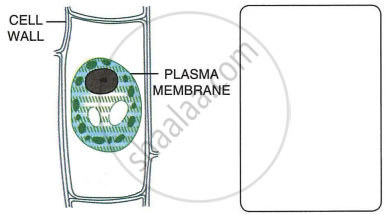
- Give the term for the state of the cell it has acquired.
- Name the structure which acts as a selectively permeable membrane.
- Comment on the nature (tonicity) of the liquid surrounding the cell.
- Name any one feature of this plant cell which is not present in an animal cell.
- Redraw in the space provided, the diagram of the cell if it is soon placed in ordinary water for some time.
Give suitable biological reasons for the following statement:
Root hairs become flaccid and droop when excess fertilizers are added to the moist soil around them.
Differentiate between the following
Turgor pressure and Root pressure
Differentiate between the following:
Plasmolysis and Deplasmolysis.
Give Technical Term for the following.
A cell in a fully extended condition.
Give Technical Term for the following.
The pressure exerted by cell contents on a plant cell wall.
Name the following:
The condition in which the contents of a cell exert pressure against the cell wall making it distended.
Multiple Choice Question:
When cell is fully turgid, which of the following will be zero?
