Advertisements
Advertisements
Question
Give the equivalent term for the following:
The condition in which the cell contents are shrunken.
Advertisements
Solution
Flaccidity
APPEARS IN
RELATED QUESTIONS
Fig. represents aprocess in plants. The set up was placed in bright sunlight. Answer the following questions:
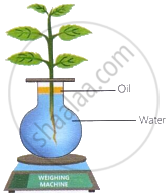
-
- Name the physiological process depicted in the figure.
- Why was oil added to the water?
- When placed in bright sunlight for four hours, what do you observe with regard to the initial and final weight of the plant? Give a suitable reason for your answer.
- What happens to the level of water when this setup is placed in:
- Humid conditions?
- Windy conditions?
- Mention any three adaptations found in plants to overcome the process mentioned in (a).
- Explain the term ‘Guttation’.
The state of a cell in which the cell wall is rigid and stretched by the increase in volume due to the absorption of water is called.
Differentiate between the following:
Turgidity and Flaccidity
Differentiate between:
Turgid and Flaccid.
Differentiate between the following:
Plasmolysis and Deplasmolysis.
Mention, if the following statement is True or False. If false rewrite the wrong statement in its correct form:
Flaccidity is the reverse of turgidity.
Fill in the Blank
The condition opposite to turgid is ___________.
Excessive use of fertilisers in agricultural fields reduces the yield of crops. Justify the statement.
When the cells of a plant are fully distended, the condition is called ______.
Given below is the figure of a plant cell showing different kinds of pressure acting upon it. Study the figure and answer the questions that follow:

- In the figure, 1, 2 and 3 represent:
- Cytoplasm, Nucleus, Vacuole respectively
- Vacuole, Cytoplasm, Cell wall respectively.
- Cytoplasm, Cell membrane and vacuole respectively.
- Cytoplasm, Cell wall and Vacuole respectively.
- B in the figure represents:
- Osmotic pressure
- Turgor pressure
- Wall pressure
- Diffusion pressure
- A in the figure represents:
- irnbibition pressure
- Wall pressure
- Turgor pressure
- Osmotic pressure
- C in the figure represents:
- Turgor pressure
- Osmotic pressure
- Wall pressure
- Imbibition pressure
- Draw a neat and labelled diagram of a plasmolyzed plant cell.
