Advertisements
Advertisements
Question
Give reason as to why hydrogen chloride can be termed as a polar covalent compound.
Advertisements
Solution
\[\ce{H\bullet {×}\overset{\times\times}{\underset{××}{Cl}^{×}_{×}}-> H\bullet {×}\overset{××}{\underset{××}{Cl}^{×}_{×}}->H\bullet {×}\overset{××}{\underset{××}{Cl}^{×}_{×}}->H^{δ+} \bullet {×}\overset{××}{\underset{××}{Cl}}^×_×}^{δ-}\]
HCl is a covalent compound formed by sharing one electron between chlorine and hydrogen. Because chlorine is more electronegative than hydrogen, the shared pair of electrons shifts towards the chlorine atom. So, a partial negative charge (δ-) develops on chlorine and a partial positive charge (δ+) develops on hydrogen. Hence, the covalent bond is polar in nature.
APPEARS IN
RELATED QUESTIONS
Butanone is a four-carbon compound with the functional group:
How is buckminsterfullerene related to diamond and graphite?
Explain why, graphite can be used as a lubricant but diamond cannot.
One of the following compounds is not ionic in nature. This compound is:
The number of isomers formed by the hydrocarbon with molecular formula C5H12 is ______.
Which element exhibits the property of catenation to maximum extent and why?
Complete the following activity.
Write the names of the hydrocarbons for the following structural formula.
(isobutylene, cyclohexane, propene, cyclohexene, cyclopentane, benzene, propyne, isobutane, propane)
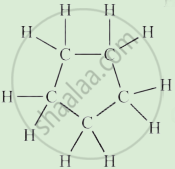 |
When ethyl alcohol and acetic acid are mixed, the resulting ester has a chemical formula ______.
Assertion (A): Melting point and boiling point of ethanol are lower than that of sodium chloride.
Reason (R): The forces of attraction between the molecules of ionic compounds are very strong.
Explain dipole (polar) molecule by taking hydrogen chloride as an example.
