Advertisements
Advertisements
Question
Give reason for the following:
A plant cell, when kept in a hypertonic salt solution for about 30 minutes, turns flaccid.
Advertisements
Solution
In a hypertonic solution, the solution outside the cell has a higher solute concentration than the fluids inside the cell. Therefore, water flows out of the plant cell due to exosmosis. The cytoplasm shrinks, the plasma membrane withdraws away from the cell wall and the cell becomes flaccid. Hence, a plant cell, when kept in a hypertonic salt solution for about 30 minutes, turns flaccid.
APPEARS IN
RELATED QUESTIONS
A plant cell may burst when :
Explain Turgor pressure
Give scientific reasons : Balsam plants wilt during mid-day even if the soil is well watered.
Give reasons for the following:
If you sprinkle some common salt on grass growing on a lawn, it is killed at that spot.
Give reason for the following:
It is better to transplant seedlings in a flower-bed in the evening and not in the morning.
Differentiate between the following
Turgor pressure and Root pressure
The below diagram represents a plant cell after being placed in a strong sugar solution. Guidelines 1 to 5 indicate the following: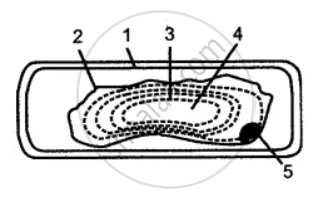
1. Cell wall
2. Plasma membrane.
3. Protoplasm
4. Large vacuole
5. Nucleus
Study the diagram and answer the questions that follow :
(i) What is the state of the cell shown in the diagram?
(ii) Name the structure which acts as a selectively permeable membrane.
(iii) If the cell had been placed in distilled water instead of a strong sugar solution which features: would not have been present?
(iv) If the cell in the diagram possessed chloroplasts where would these be present?
(v) Name any one feature of this plant cell which is not present in animal cells.
Mention, if the following statement is True or False. If false rewrite the wrong statement in its correct form:
Flaccidity is the reverse of turgidity.
When the cells of a plant are fully distended, the condition is called ______.
Given below is the figure of a plant cell showing different kinds of pressure acting upon it. Study the figure and answer the questions that follow:

- In the figure, 1, 2 and 3 represent:
- Cytoplasm, Nucleus, Vacuole respectively
- Vacuole, Cytoplasm, Cell wall respectively.
- Cytoplasm, Cell membrane and vacuole respectively.
- Cytoplasm, Cell wall and Vacuole respectively.
- B in the figure represents:
- Osmotic pressure
- Turgor pressure
- Wall pressure
- Diffusion pressure
- A in the figure represents:
- irnbibition pressure
- Wall pressure
- Turgor pressure
- Osmotic pressure
- C in the figure represents:
- Turgor pressure
- Osmotic pressure
- Wall pressure
- Imbibition pressure
- Draw a neat and labelled diagram of a plasmolyzed plant cell.
