Advertisements
Advertisements
Question
Give one example of zero order reaction.
Advertisements
Solution
Decomposition of nitrous oxide in the presence of Pt catalyst.
\[\ce{2N2O_{(g)} ->[Pt] 2N_{2(g)} + O_{2(g)}}\]
APPEARS IN
RELATED QUESTIONS
The reaction between A and B is first order with respect to A and zero order with respect to B. Fill in the blanks in the following table:
| Experiment | A/mol L−1 | B/mol L−1 | Initial rate/mol L−1 min−1 |
| I | 0.1 | 0.1 | 2.0 × 10⁻² |
| II | ______ | 0.2 | 4.0 × 10⁻² |
| III | 0.4 | 0.4 | ______ |
| IV | ______ | 0.2 | 2.0 × 10⁻² |
Derive integrated rate law for a zero-order reaction \[\ce{A -> Product}\].
For which of the following reaction the units of rate constant and rate of the reaction are same?
At high pressure the following reaction is zero order.
\[\ce{2NH3(g) ->[1130 K][Platinum catalyst] N2(g) + 3H2(g)}\]
Which of the following options are correct for this reaction?
(i) Rate of reaction = Rate constant.
(ii) Rate of the reaction depends on concentration of ammonia.
(iii) Rate of decomposition of ammonia will remain constant until ammonia disappears completely.
(iv) Further increase in pressure will change the rate of reaction.
Which of the following graphs is correct for a zero order reaction?
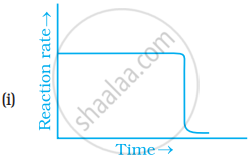

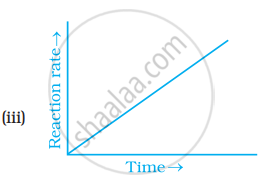

Write the rate equation for the reaction `2A + B -> C` if the order of the reaction is zero.
Derive an expression to calculate time required for completion of zero order reaction.
A solution with initial concentration of a mol dm-3 follow zero order kinetic. The time taken for the completion of reaction is
Consider the following statement:-
(i) Increase in concentration of reactant increases the rate of a zero-order reaction.
(ii) Rate constant k is equal to collision frequency A if Ea = 0
(iii) Rate constant k is equal to collision frequency A if Ea = 0
(iv) In k vs t is a straight line
(v) In k vs 1/T is a straight line
Which of the above statement is correct?
Write the expression of integrated rate equation for zero order reaction.
The slope in the plot of [R] Vs. time for a zero-order reaction is ______.
Assertion (A): For a zero-order reaction, the unit of rate constant and rate of reaction are same.
Reason (R): Rate of reaction for zero order reaction is independent of concentration of reactant.
If the initial concentration of substance A is 1.5 M and after 120 seconds the concentration of substance A is 0.75 M, the rate constant for the reaction if it follows zero-order kinetics is ______.
What is zeroth order reaction? Derive its integrated rate Law. What are the units of rate constant?
Derive integrated rate law for zero order reaction.
Write the unit of rate constant of zero order reaction.
What is zero order reaction?
If unit of rate constant is mol dm−3s−1, the order of reaction would be ______.
