Advertisements
Advertisements
Question
The decomposition of NH3 on a platinum surface is a zero-order reaction. If the rate constant (k) is 4 x 10⁻³ ms-1, how long will it take to reduce the initial concentration of NH3 from 0.1 M to 0.064 M?
Advertisements
Solution
Given that:
k = 4 x 10⁻³ Ms-1
`["A"_°]` = 0.1 M
[A] = 0.064 M
For a zero-order reaction,
k=`1/t {["A"_°]-["A"]}`
4 x 10⁻³ Ms-1 = `1/"t" {[0.1]-[0.064]}`
t =`( 0.1-0.064)/(4xx10^-3)=0.009xx10^3=9` seconds
RELATED QUESTIONS
The decomposition of NH3 on platinum surface is zero order reaction. What are the rates of production of N2 and H2 if k = 2.5 × 10⁻⁴ mol−1 L s−1?
The reaction between A and B is first order with respect to A and zero order with respect to B. Fill in the blanks in the following table:
| Experiment | A/mol L−1 | B/mol L−1 | Initial rate/mol L−1 min−1 |
| I | 0.1 | 0.1 | 2.0 × 10⁻² |
| II | ______ | 0.2 | 4.0 × 10⁻² |
| III | 0.4 | 0.4 | ______ |
| IV | ______ | 0.2 | 2.0 × 10⁻² |
Give one example of zero order reaction.
For which of the following reaction the units of rate constant and rate of the reaction are same?
Which of the following graphs is correct for a zero order reaction?
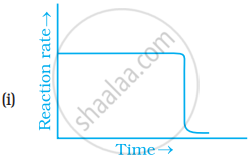

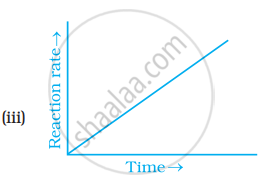

A solution with initial concentration of a mol dm-3 follow zero order kinetic. The time taken for the completion of reaction is
Consider the following statement:-
(i) Increase in concentration of reactant increases the rate of a zero-order reaction.
(ii) Rate constant k is equal to collision frequency A if Ea = 0
(iii) Rate constant k is equal to collision frequency A if Ea = 0
(iv) In k vs t is a straight line
(v) In k vs 1/T is a straight line
Which of the above statement is correct?
The slope in the plot of [R] Vs. time for a zero-order reaction is ______.
If the initial concentration of substance A is 1.5 M and after 120 seconds the concentration of substance A is 0.75 M, the rate constant for the reaction if it follows zero-order kinetics is ______.
What is zeroth order reaction? Derive its integrated rate Law. What are the units of rate constant?
