Advertisements
Advertisements
Question
Give one chemical test to distinguish between the following pair of compounds.
Secondary and tertiary amines
Advertisements
Solution
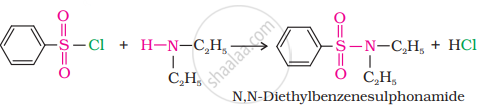
Secondary and tertiary amines can be distinguished by allowing them to react with Hinsberg’s reagent (benzenesulphonyl chloride, C6H5SO2Cl).
Secondary amines react with Hinsberg’s reagent to form a product that is insoluble in an alkali. For example, N, N−diethylamine reacts with Hinsberg’s reagent to form N, N−diethylbenzenesulphonamide, which is insoluble in an alkali. Tertiary amines, however, do not react with Hinsberg’s reagent.
APPEARS IN
RELATED QUESTIONS
Which among the following molecular formulae represents urotropine?
(a) C6H12N4
(b) C6H24H4
(c) C6H12N4O2
(d) C6H24N4O2
Convert 3-Methylaniline into 3-nitrotoluene.
Write the IUPAC name of the following compound and classify it as primary, secondary and tertiary amine.
(CH3)3CNH2
Give one chemical test to distinguish between the following pair of compounds.
Ethylamine and aniline
Account for the following:
pKb of aniline is more than that of methylamine.
How will you convert methanol to ethanoic acid?
How will you convert ethanoic acid into propanoic acid?
How will you convert nitromethane into dimethylamine?
Accomplish the following conversion:
Aniline to 2, 4, 6-tribromofluorobenzene
Accomplish the following conversion:
Chlorobenzene to p-chloroaniline
Accomplish the following conversion:
Aniline to benzyl alcohol
An aromatic compound ‘A’ on treatment with aqueous ammonia and heating forms compound ‘B’ which on heating with Br2 and KOH forms a compound ‘C’ of molecular formula C6H7N. Write the structures and IUPAC names of compounds A, B and C.
Complete the following reaction:
\[\ce{C6H5NH2 + H2SO4 (conc.)}\]
Complete the following reaction:
\[\ce{C6H5NH2 + Br2 (aq) ->}\]
Complete the following reaction:
\[\ce{C6H5N2Cl ->[(i) HBF4][(ii) NaNO2/Cu, \Delta]}\]
The following amine is called as:

An organic compound (A) with molecular formula C3H7NO on heating with Br2 and KOH forms a compound (B). Compound (B) on heating with CHCl3 and alcoholic KOH produces a foul-smelling compound (C) and on reacting with C6H5SO2Cl forms a compound (D) which is soluble in alkali. Write the structure of (A), (B), (C) and (D).
Do the following conversions in not more than two steps:
\[\begin{array}{cc}
\ce{CH3CN to CH3 - C - CH3}\\
\phantom{...........}||\\
\phantom{...........}\ce{O}
\end{array}\]
Do the following conversions in not more than two steps:

