Advertisements
Advertisements
Question
Give geographical reasons for the following:
There are limitations on mining in the interior parts of Brazil.
Advertisements
Solution
There are limitations on mining in the interior parts of Brazil due to the following reasons:
- Dense Forest Cover: The Amazon rainforest covers a large portion of Brazil’s interior, making access to mineral-rich areas very difficult and restricting large-scale mining activities.
- Poor Transportation Facilities: The lack of proper roads and railways in the interior regions makes it hard to transport heavy machinery and minerals, increasing the cost and difficulty of mining.
- Unfavourable Climate: The hot and humid equatorial climate with heavy rainfall creates challenging working conditions and hinders mining operations.
- Environmental Concerns: Mining in the Amazon basin can cause deforestation, soil erosion, and loss of biodiversity, so strict environmental regulations limit such activities.
APPEARS IN
RELATED QUESTIONS
Select the correct option and rewrite the sentence:
------------ is seen as one of the world’s major markets and contributor to economic growth of the world.
Draw a suitable Line graph with the help of the following statistical information and answer the following questions.
| Number of international tourists (in lakhs) | |||||
| International tourists (in lakhs) |
1995 | 2000 | 2005 | 2010 | 2015 |
| Brazil | 20 | 50 | 45 | 40 | 50 |
| India | 20 | 21 | 30 | 50 | 140 |
- In which year is the number of tourists maximum in India?
- In the year 2000, how many tourists visited Brazil?
- In which year do India and Brazil have the same number of international tourists?
Mark the following in the outline map of Brazil supplied to you, write the names and give index

- Marajó Island
- Pico-De-Neblina
- Pantanal Wetland
- Drought Quadrilateral
- Caatinga
- Golden Lion-Tamarin
Mark the following in the outline map of Brazil supplied to you, write the names and give index:
(1) Marajo Island
(2) Pico-De-Neblina
(3) Pantanal Wetland
(4) Drought Quadrilateral
(5) Caatinga
(6) Golden Lion-Tamarin
The economies of India and Brazil are of the ______ type.
Give reasons.
There is mixed economy in Brazil and India.
Read the following graph and answer the questions:
Gross National Incomes (GNI) from 1960 to 2016 (in million US $)
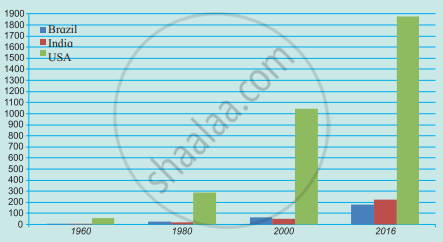
- Which country’s national income was highest in 2016 and was it how much?
- Comparing India and Brazil, which country had a higher national income in 1980?
- Comparing India and Brazil, which country had a higher income in 2016?
- Tell the difference between the GNP of Brazil and India in 2016.
- Calculate the difference between the national incomes of developed and developing countries in 2016.
In figure given below, the pie-charts show the contribution of each sector in the respective country’s GDP and the percentage of population engaged in various activities. Read both the pie-charts carefully and answer the following questions.
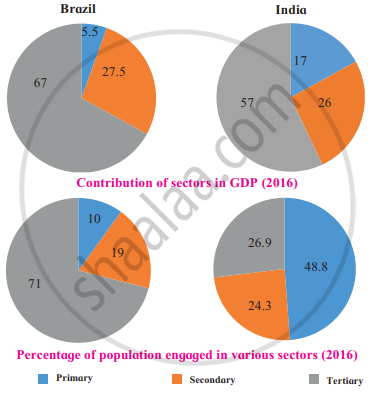
- Which country has a higher percentage of population engaged in primary activities?
- In which country is the contribution of tertiary sector greater in the GDP?
- In which country is the share of secondary activities more in the GDP?
- Can we say that Brazil is an agrarian economy like India? Give reasons.
Read the following graph and answer the questions:
India and Brazil Contribution of sectors in national income and percentage of population engaged in the sector.

- Name the sectors mentioned in the graph.
- Which sector contributes the highest in National income in India?
- How much percent of population is engaged in primary sector in Brasil?
Read the following graph and answer the questions:
India and Brazil
Contribution of sectors in national income and percentage of population engaged in the sector.
Questions:
- Name the sectors mentioned in the graph.
- Which sector contributes the highest in National income in India?
- How much percent of population is engaged in primary sector in Brazil?
- Out of given two countries, the share of primary sector to the national income is less.
- Which country's contribution of tertiary sector to the national income is less?
- In which sector 19% population of Brazil is engaged?
