Advertisements
Advertisements
Question
Give a reason for the following.
Nitric acid in the dilute form is not used in the laboratory preparation of hydrogen from metals.
Advertisements
Solution
Nitric acid is a strong oxidising agent and nascent oxygen formed oxidises hydrogen produced to water.
APPEARS IN
RELATED QUESTIONS
Name the following:
A metal which liberates hydrogen only when steam is passed over red hot metal.
Name the following:
A metallic oxide which can be reduced into metal by hydrogen.
Draw a neat and well-labelled diagram for the laboratory preparation of hydrogen.
FILL IN THE BLANK
........................ zinc is preferred over pure zinc in the laboratory preparation of hydrogen.
How would you show that hydrogen is lighter than air?
In the laboratory preparation of hydrogen from zinc & dilute hydrocholoric acid – state a reason for the addition of traces of copper [II] sulphate to the reaction medium.
Give reason for the following:
Copper does not displace hydrogen from dilute hydrochloric acid, but zinc does.
Give a balanced equation for the following conversions sodium plumbite from lead.
The diagram represent the preparation and collection of hydrogen by a standard
laboratory method.
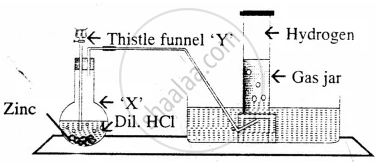
State what is added through the thistle funnel ‘Y’
The diagram represent the preparation and collection of hydrogen by a standard laboratory method.
State, why hydrogen is collected after all the air in the apparatus, is allowed to escape.
