Advertisements
Advertisements
Question
For the given cell, \[\ce{Mg | Mg^{2+} || Cu^{2+} | Cu}\]
(i) \[\ce{Mg}\] is cathode
(ii) \[\ce{Cu}\] is cathode
(iii) The cell reaction is \[\ce{Mg^+ Cu^{2+} -> Mg^{2+} + Cu}\]
(iv) \[\ce{Cu}\] is the oxidising agent
Advertisements
Solution
(ii) \[\ce{Cu}\] is cathode
(iii) The cell reaction is \[\ce{Mg^+ Cu^{2+} -> Mg^{2+} + Cu}\]
Explanation:
(i) Left side of cell reaction represents oxidation half-cell i.e., oxidation of \[\ce{Mg}\] and right side of cell represents reduction half-cell reactions i.e., reduction of copper.
(ii) \[\ce{Cu}\] is reduced and reduction occurs at cathode.
(iii) \[\ce{Mg}\] is oxidized and oxidation occurs at anode.
(iv) Whole cell reaction can be written as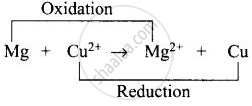
APPEARS IN
RELATED QUESTIONS
How many moles of electrons are required for reduction of 2 moles of Zn2+ to Zn?
For the electrochemical cell:
\[\ce{M | M+ || X- | X}\];
\[\ce{E^{\circ}_{{M^{+}/{M}}}}\] = 0.44 V,
\[\ce{E^{\circ}_{X/X^-}}\] = 0.33 V
Which of the following is TRUE for this data?
A solution of Cu(NO3)2 is electrolyzed between platinum electrodes using 0.1 Faraday electricity. How many moles of Cu will be deposited at the cathode?
A certain current liberated 0.504 gm of hydrogen in 2 hours. How many grams of copper can be liberated by the same current flowing for the same time through copper sulphate solution.
Define anode
Why is anode in galvanic cell considered to be negative and cathode positive electrode?
Can Fe3+ oxidises bromide to bromine under standard conditions?
Given: \[\ce{E^0_{{Fe^{3+}|Fe^{2+}}}}\] = 0.771 V
\[\ce{E^0_{{Br_{2}|Br^-}}}\] = −1.09 V
Reduction potential of two metals M1 and M2 are \[\ce{E^0_{{M_1^{2+}|M_1}}}\] = −2.3 V and \[\ce{E^0_{{M_2^{2+}|M_2}}}\] = 0.2 V. Predict which one is better for coating the surface of iron.
Given: \[\ce{E^0_{{Fe^{2+}|Fe}}}\] = −0.44 V
An electrochemical cell can behave like an electrolytic cell when ______.
Use the data given in below find out the most stable ion in its reduced form.
`"E"_("Cr"_2"O"_7^(2-)//"Cr"^(3+))^⊖`= 1.33 V `"E"_("Cl"_2//"Cl"^-)^⊖` = 1.36 V
`"E"_("MnO"_4^-//"Mn"^(2+))^⊖` = 1.51 V `"E"_("Cr"^(3+)//"Cr")^⊖` = - 0.74 V
Can absolute electrode potential of an electrode be measured?
A galvanic cell has electrical potential of 1.1V. If an opposing potential of 1.1V is applied to this cell, what will happen to the cell reaction and current flowing through the cell?
How will the pH of brine (aq. \[\ce{NaCl}\] solution) be affected when it is electrolysed?
Which of the following statements about galvanic cell is incorrect
Read the passage given below and answer the questions that follow:
|
Oxidation-reduction reactions are commonly known as redox reactions. They involve transfer of electrons from one species to another. In a spontaneous reaction, energy is released which can be used to do useful work. The reaction is split into two half-reactions. Two different containers are used and a wire is used to drive the electrons from one side to the other and a Voltaic/Galvanic cell is created. It is an electrochemical cell that uses spontaneous redox reactions to generate electricity. A salt bridge also connects to the half-cells. The reading of the voltmeter gives the cell voltage or cell potential or electromotive force. If \[\ce{E^0_{cell}}\] is positive the reaction is spontaneous and if it is negative the reaction is non-spontaneous and is referred to as electrolytic cell. Electrolysis refers to the decomposition of a substance by an electric current. One mole of electric charge when passed through a cell will discharge half a mole of a divalent metal ion such as Cu2+. This was first formulated by Faraday in the form of laws of electrolysis.
|

- Is silver plate the anode or cathode? (1)
- What will happen if the salt bridge is removed? (1)
- When does electrochemical cell behaves like an electrolytic cell? (1)
- (i) What will happen to the concentration of Zn2+ and Ag+ when Ecell = 0. (1)
(ii) Why does conductivity of a solution decreases with dilution? (1)
OR
The molar conductivity of a 1.5 M solution of an electrolyte is found to be 138.9 S cm2mol-1. Calculate the conductivity of this solution. (2)
On which electrode the oxidation reaction takes place?
Which of the following is incorrect?
The number of moles of electrons passed when the current of 2 A is passed through a solution of electrolyte for 20 minutes is ______.
Explain why the anode is of negative polarity in a galvanic cell.
Explain the types of electrochemical cells.
