Advertisements
Advertisements
प्रश्न
For the given cell, \[\ce{Mg | Mg^{2+} || Cu^{2+} | Cu}\]
(i) \[\ce{Mg}\] is cathode
(ii) \[\ce{Cu}\] is cathode
(iii) The cell reaction is \[\ce{Mg^+ Cu^{2+} -> Mg^{2+} + Cu}\]
(iv) \[\ce{Cu}\] is the oxidising agent
Advertisements
उत्तर
(ii) \[\ce{Cu}\] is cathode
(iii) The cell reaction is \[\ce{Mg^+ Cu^{2+} -> Mg^{2+} + Cu}\]
Explanation:
(i) Left side of cell reaction represents oxidation half-cell i.e., oxidation of \[\ce{Mg}\] and right side of cell represents reduction half-cell reactions i.e., reduction of copper.
(ii) \[\ce{Cu}\] is reduced and reduction occurs at cathode.
(iii) \[\ce{Mg}\] is oxidized and oxidation occurs at anode.
(iv) Whole cell reaction can be written as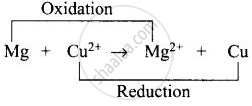
APPEARS IN
संबंधित प्रश्न
Define the following term:
Fuel cell
E°cell for the given redox reaction is 2.71 V
Mg(s) + Cu2+ (0.01 M) → Mg2+ (0.001 M) + Cu(s)
Calculate Ecell for the reaction. Write the direction of flow of current when an external opposite potential applied is
(i) less than 2.71 V and
(ii) greater than 2.71 V
What is the SI unit tor electrochemical equivalent?
At 25°C, the emf of the following electrochemical cell.
\[\ce{Ag_{(s)} | Ag^+ (0.01 M) | | Zn^{2+} {(0.1 M)} | Zn_{(s)}}\] will be:
(Given \[\ce{E^0_{cell}}\] = −1.562 V)
Zinc can be coated on iron to produce galvanized iron but the reverse is not possible. It is because ____________.
A certain current liberated 0.504 gm of hydrogen in 2 hours. How many grams of copper can be liberated by the same current flowing for the same time through copper sulphate solution.
Cell equation: \[\ce{A + 2B^- -> A^{2+} + 2B}\]
\[\ce{A^{2+} + 2e^- -> A}\] E0 = +0.34 V and log10 k = 15.6 at 300 K for cell reactions find E0 for \[\ce{B^+ + e^- -> B}\]
Describe the construction of Daniel cell. Write the cell reaction.
For the cell \[\ce{Mg_{(s)}|Mg^{2+}_{( aq)}||Ag^+_{( aq)}|Ag_{(s)}}\], calculate the equilibrium constant at 25°C and maximum work that can be obtained during operation of cell.
Given: \[\ce{E^0_{{Mg^{2+}|Mg}}}\] = −2.37 V and \[\ce{E^0_{{Ag^{+}|Ag}}}\] = 0.80 V
Write a note on sacrificial protection.
Which of the following statement is not correct about an inert electrode in a cell?
Use the data given in below find out the most stable oxidised species.
`E^0 (Cr_2O_1^(2-))/(Cr_(3+))` = 1.33 V `E^0 (Cl_2)/(Cl^-)` = 1.36 V
`E^0 (MnO_4^-)/(MN^(2+))` = 1.51 V `E^0 (Cr^(3+))/(Cr)` = – 0.74 V
The quantity of charge required to obtain one mole of aluminium from Al2O3 is ______.
Consider the following diagram in which an electrochemical cell is coupled to an electrolytic cell. What will be the polarity of electrodes ‘A’ and ‘B’ in the electrolytic cell?
Standard reduction electrode potentials of three metals A, B and C are respectively + 0.5 V, – 3.0 V. and – 1.2 V. The reducing powers of there metal is.
Cell reaction is spontaneous when
If 0.5 amp current is passed through acidified silver nitrate then in 100 minutes the mass of silver, deposite on cathode is (eq. wt. of silver nitrate + 108).
On which electrode the oxidation reaction takes place?
State the term for the following:
Two metal plates or wires through which the current enters and leaves the electrolytic cell.
