Advertisements
Advertisements
प्रश्न
For the given cell, \[\ce{Mg | Mg^{2+} || Cu^{2+} | Cu}\]
(i) \[\ce{Mg}\] is cathode
(ii) \[\ce{Cu}\] is cathode
(iii) The cell reaction is \[\ce{Mg^+ Cu^{2+} -> Mg^{2+} + Cu}\]
(iv) \[\ce{Cu}\] is the oxidising agent
Advertisements
उत्तर
(ii) \[\ce{Cu}\] is cathode
(iii) The cell reaction is \[\ce{Mg^+ Cu^{2+} -> Mg^{2+} + Cu}\]
Explanation:
(i) Left side of cell reaction represents oxidation half-cell i.e., oxidation of \[\ce{Mg}\] and right side of cell represents reduction half-cell reactions i.e., reduction of copper.
(ii) \[\ce{Cu}\] is reduced and reduction occurs at cathode.
(iii) \[\ce{Mg}\] is oxidized and oxidation occurs at anode.
(iv) Whole cell reaction can be written as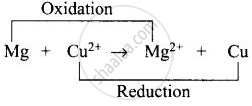
APPEARS IN
संबंधित प्रश्न
Write cathode and anode reaction in a fuel cell.
A solution of CuSO4 is electrolysed using a current of 1.5 amperes for 10 minutes. What mass of Cu is deposited at cathode? [Atomic mass of Cu = 63.7]
A solution of Cu(NO3)2 is electrolyzed between platinum electrodes using 0.1 Faraday electricity. How many moles of Cu will be deposited at the cathode?
At 25°C, the emf of the following electrochemical cell.
\[\ce{Ag_{(s)} | Ag^+ (0.01 M) | | Zn^{2+} {(0.1 M)} | Zn_{(s)}}\] will be:
(Given \[\ce{E^0_{cell}}\] = −1.562 V)
Consider the change in the oxidation state of Bromine corresponding to different emf values as shown in the expression below:
\[\ce{BrO^-_4 ->[1.82 V] BrO^-_3 ->[1.5 V] HBrO ->[1.595 V] Br2 ->[1.0652 V] Br^-}\]
Then the species undergoing disproportionation is:
Can Fe3+ oxidises bromide to bromine under standard conditions?
Given: \[\ce{E^0_{{Fe^{3+}|Fe^{2+}}}}\] = 0.771 V
\[\ce{E^0_{{Br_{2}|Br^-}}}\] = −1.09 V
For the cell \[\ce{Mg_{(s)}|Mg^{2+}_{( aq)}||Ag^+_{( aq)}|Ag_{(s)}}\], calculate the equilibrium constant at 25°C and maximum work that can be obtained during operation of cell.
Given: \[\ce{E^0_{{Mg^{2+}|Mg}}}\] = −2.37 V and \[\ce{E^0_{{Ag^{+}|Ag}}}\] = 0.80 V
Write a note on sacrificial protection.
Which of the following statement is not correct about an inert electrode in a cell?
Use the data given in below find out which option the order of reducing power is correct.
`"E"_("Cr"_2"O"_7^(2-)//"Cr"^(3+))^⊖`= 1.33 V `"E"_("Cl"_2//"Cl"^-)^⊖` = 1.36 V
`"E"_("MnO"_4^-//"Mn"^(2+))^⊖` = 1.51 V `"E"_("Cr"^(3+)//"Cr")^⊖` = - 0.74 V
Use the data given in below find out the most stable ion in its reduced form.
`"E"_("Cr"_2"O"_7^(2-)//"Cr"^(3+))^⊖`= 1.33 V `"E"_("Cl"_2//"Cl"^-)^⊖` = 1.36 V
`"E"_("MnO"_4^-//"Mn"^(2+))^⊖` = 1.51 V `"E"_("Cr"^(3+)//"Cr")^⊖` = - 0.74 V
Match the terms given in Column I with the units given in Column II.
| Column I | Column II |
| (i) Λm | (a) S cm-¹ |
| (ii) ECell | (b) m-¹ |
| (iii) K | (c) S cm2 mol-¹ |
| (iv) G* | (d) V |
The correct order of the mobility of the alkali metal ions. In aqueous solultion is
Which of the following is incorrect?
In a solution of CuSO4, how much time will be required to precipitate 2 g copper by 0.5 ampere current?
Galvanic cell is a device in which ______.
Calculate the λ0m for Cl- ion from the data given below:
∧0m MgCl2 = 258.6 Scm2 mol-1 and λ0m Mg2+ = 106 Scm2 mol-1
What are electrochemical reactions?
