Advertisements
Advertisements
प्रश्न
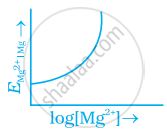
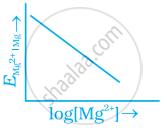
Electrode potential for Mg electrode varies according to the equation
`E_(Mg^(2+) | Mg) = E_(Mg^(2+) | Mg)^Θ - 0.059/2 log 1/([Mg^(2+)])`. The graph of `E_(Mg^(2+) | Mg)` vs `log [Mg^(2+)]` is ______.
पर्याय

Advertisements
उत्तर
Electrode potential for Mg electrode varies according to the equation
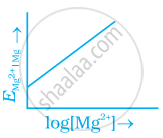
`E_(Mg^(2+) | Mg) = E_(Mg^(2+) | Mg)^Θ - 0.059/2 log 1/([Mg^(2+)])`. The graph of `E_(Mg^(2+) | Mg)` vs `log [Mg^(2+)]` is a straignt line with a positive slope and intercept `E_((Mg^(2+))/(Mg)`.
Explanation:
`E_(Mg^(2+) | mg) = E_(Mg^(2+) | Mg)^Θ - 0.059/2 log [Mg^(2+)]`
Compare this equation with the equation of straingt line y = mx + c.
The graph of `E_(Mg^(2+) | Mg)` versus `log [Mg^(2+)]` is a straignt line with a positive slope and intercept `E_((Mg^(2+))/(Mg)`.
APPEARS IN
संबंधित प्रश्न
How many faradays of electricity are required to produce 6 g of Mg from MgCl2?
At 25°C, the emf of the following electrochemical cell.
\[\ce{Ag_{(s)} | Ag^+ (0.01 M) | | Zn^{2+} {(0.1 M)} | Zn_{(s)}}\] will be:
(Given \[\ce{E^0_{cell}}\] = −1.562 V)
Zinc can be coated on iron to produce galvanized iron but the reverse is not possible. It is because ____________.
A certain current liberated 0.504 gm of hydrogen in 2 hours. How many grams of copper can be liberated by the same current flowing for the same time through copper sulphate solution.
A gas X at 1 atm is bubbled through a solution containing a mixture of 1 MY− and 1 MZ− at 25°C. If the reduction potential of Z > Y > X, then ______.
Describe the electrolysis of molten NaCl using inert electrodes.
Can Fe3+ oxidises bromide to bromine under standard conditions?
Given: \[\ce{E^0_{{Fe^{3+}|Fe^{2+}}}}\] = 0.771 V
\[\ce{E^0_{{Br_{2}|Br^-}}}\] = −1.09 V
Reduction potential of two metals M1 and M2 are \[\ce{E^0_{{M_1^{2+}|M_1}}}\] = −2.3 V and \[\ce{E^0_{{M_2^{2+}|M_2}}}\] = 0.2 V. Predict which one is better for coating the surface of iron.
Given: \[\ce{E^0_{{Fe^{2+}|Fe}}}\] = −0.44 V
Which of the following statement is not correct about an inert electrode in a cell?
Use the data given in below find out which option the order of reducing power is correct.
`"E"_("Cr"_2"O"_7^(2-)//"Cr"^(3+))^⊖`= 1.33 V `"E"_("Cl"_2//"Cl"^-)^⊖` = 1.36 V
`"E"_("MnO"_4^-//"Mn"^(2+))^⊖` = 1.51 V `"E"_("Cr"^(3+)//"Cr")^⊖` = - 0.74 V
The quantity of charge required to obtain one mole of aluminium from Al2O3 is ______.
`E_(cell)^Θ` for some half cell reactions are given below. On the basis of these mark the correct answer.
(a) \[\ce{H^{+} (aq) + e^{-} -> 1/2 H_2 (g); E^Θ_{cell} = 0.00V}\]
(b) \[\ce{2H2O (1) -> O2 (g) + 4H^{+} (aq) + 4e^{-}; E^Θ_{cell} = 1.23V}\]
(c) \[\ce{2SO^{2-}_{4} (aq) -> S2O^{2-}_{8} (aq) + 2e^{-}; E^Θ_{cell} = 1.96V}\]
(i) In dilute sulphuric acid solution, hydrogen will be reduced at cathode.
(ii) In concentrated sulphuric acid solution, water will be oxidised at anode.
(iii) In dilute sulphuric acid solution, water will be oxidised at anode.
(iv) In dilute sulphuric acid solution, \[\ce{SO4^{2-}}\] ion will be oxidised to tetrathionate ion at anode.
The electrochemical cell stops working after some time because
Cell reaction is spontaneous when
If the half-cell reaction A + e– → A– has a large negative reduction potential, it follow that:-
Which of the following is incorrect?
Galvanic cell is a device in which ______.
What should be the signs (positive/negative) for \[\ce{E^0_{cell}}\] and ΔG0 for a spontaneous redox reaction occurring under standard conditions?
Calculate the λ0m for Cl- ion from the data given below:
∧0m MgCl2 = 258.6 Scm2 mol-1 and λ0m Mg2+ = 106 Scm2 mol-1
Explain the types of electrochemical cells.
