Advertisements
Advertisements
Question
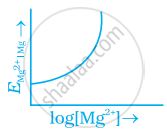
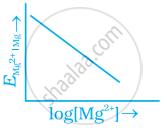
Electrode potential for Mg electrode varies according to the equation
`E_(Mg^(2+) | Mg) = E_(Mg^(2+) | Mg)^Θ - 0.059/2 log 1/([Mg^(2+)])`. The graph of `E_(Mg^(2+) | Mg)` vs `log [Mg^(2+)]` is ______.
Options

Advertisements
Solution
Electrode potential for Mg electrode varies according to the equation
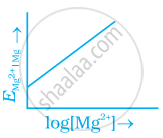
`E_(Mg^(2+) | Mg) = E_(Mg^(2+) | Mg)^Θ - 0.059/2 log 1/([Mg^(2+)])`. The graph of `E_(Mg^(2+) | Mg)` vs `log [Mg^(2+)]` is a straignt line with a positive slope and intercept `E_((Mg^(2+))/(Mg)`.
Explanation:
`E_(Mg^(2+) | mg) = E_(Mg^(2+) | Mg)^Θ - 0.059/2 log [Mg^(2+)]`
Compare this equation with the equation of straingt line y = mx + c.
The graph of `E_(Mg^(2+) | Mg)` versus `log [Mg^(2+)]` is a straignt line with a positive slope and intercept `E_((Mg^(2+))/(Mg)`.
APPEARS IN
RELATED QUESTIONS
Write cathode and anode reaction in a fuel cell.
Among Zn and Cu, which would occur more readily in nature as metal and which as an ion?
Define the following term:
Fuel cell
If one mole electrons is passed through the solutions of CrCl3, AgNO3 and NiSO4, in what ratio Cr, Ag and Ni will be deposited at the electrodes?
A current strength of 3.86 A was passed through molten Calcium oxide for 41minutes and 40 seconds. The mass of Calcium in grams deposited at the cathode is (atomic mass of Ca is 40g/mol and 1F = 96500 C).
Zinc can be coated on iron to produce galvanized iron but the reverse is not possible. It is because ____________.
Assertion: pure iron when heated in dry air is converted with a layer of rust.
Reason: Rust has the compositionFe3O4.
Define cathode
Why is anode in galvanic cell considered to be negative and cathode positive electrode?
A copper electrode is dipped in 0.1 M copper sulphate solution at 25°C. Calculate the electrode potential of copper.
[Given: \[\ce{E^0_{{Cu^{2+}|Cu}}}\] = 0.34 V]
For the given cell, \[\ce{Mg | Mg^{2+} || Cu^{2+} | Cu}\]
(i) \[\ce{Mg}\] is cathode
(ii) \[\ce{Cu}\] is cathode
(iii) The cell reaction is \[\ce{Mg^+ Cu^{2+} -> Mg^{2+} + Cu}\]
(iv) \[\ce{Cu}\] is the oxidising agent
What is electrode potential?
Consider a cell given below:
\[\ce{Cu | Cu^{2+} || Cl^{-} | Cl_{2},Pt}\]
Write the reactions that occur at anode and cathode
On which electrode the oxidation reaction takes place?
Which of the following is incorrect?
Calculate the λ0m for Cl- ion from the data given below:
∧0m MgCl2 = 258.6 Scm2 mol-1 and λ0m Mg2+ = 106 Scm2 mol-1
What is an electrochemical cell? What does it consist of?
What are electrochemical reactions?
