Advertisements
Advertisements
प्रश्न
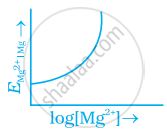
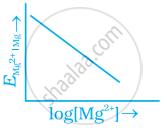
Electrode potential for Mg electrode varies according to the equation
`E_(Mg^(2+) | Mg) = E_(Mg^(2+) | Mg)^Θ - 0.059/2 log 1/([Mg^(2+)])`. The graph of `E_(Mg^(2+) | Mg)` vs `log [Mg^(2+)]` is ______.
विकल्प

Advertisements
उत्तर
Electrode potential for Mg electrode varies according to the equation
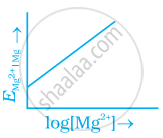
`E_(Mg^(2+) | Mg) = E_(Mg^(2+) | Mg)^Θ - 0.059/2 log 1/([Mg^(2+)])`. The graph of `E_(Mg^(2+) | Mg)` vs `log [Mg^(2+)]` is a straignt line with a positive slope and intercept `E_((Mg^(2+))/(Mg)`.
Explanation:
`E_(Mg^(2+) | mg) = E_(Mg^(2+) | Mg)^Θ - 0.059/2 log [Mg^(2+)]`
Compare this equation with the equation of straingt line y = mx + c.
The graph of `E_(Mg^(2+) | Mg)` versus `log [Mg^(2+)]` is a straignt line with a positive slope and intercept `E_((Mg^(2+))/(Mg)`.
APPEARS IN
संबंधित प्रश्न
Derive a relation between ΔH and ΔU for a chemical reaction. Draw neat labelled diagram of calomel electrode. Resistance and conductivity of a cell containing 0.001 M KCI solution at 298K are 1500Ω and 1.46x10⁻⁴ S.cm-1 respectively.
Why cannot we store AgNO3 solution in copper vessel?
For the electrochemical cell:
\[\ce{M | M+ || X- | X}\];
\[\ce{E^{\circ}_{{M^{+}/{M}}}}\] = 0.44 V,
\[\ce{E^{\circ}_{X/X^-}}\] = 0.33 V
Which of the following is TRUE for this data?
A current strength of 3.86 A was passed through molten Calcium oxide for 41minutes and 40 seconds. The mass of Calcium in grams deposited at the cathode is (atomic mass of Ca is 40g/mol and 1F = 96500 C).
Zinc can be coated on iron to produce galvanized iron but the reverse is not possible. It is because ____________.
Cell equation: \[\ce{A + 2B^- -> A^{2+} + 2B}\]
\[\ce{A^{2+} + 2e^- -> A}\] E0 = +0.34 V and log10 k = 15.6 at 300 K for cell reactions find E0 for \[\ce{B^+ + e^- -> B}\]
A gas X at 1 atm is bubbled through a solution containing a mixture of 1 MY− and 1 MZ− at 25°C. If the reduction potential of Z > Y > X, then ______.
Define anode
Reduction potential of two metals M1 and M2 are \[\ce{E^0_{{M_1^{2+}|M_1}}}\] = −2.3 V and \[\ce{E^0_{{M_2^{2+}|M_2}}}\] = 0.2 V. Predict which one is better for coating the surface of iron.
Given: \[\ce{E^0_{{Fe^{2+}|Fe}}}\] = −0.44 V
A copper electrode is dipped in 0.1 M copper sulphate solution at 25°C. Calculate the electrode potential of copper.
[Given: \[\ce{E^0_{{Cu^{2+}|Cu}}}\] = 0.34 V]
Which of the following statement is not correct about an inert electrode in a cell?
Use the data given in below find out which option the order of reducing power is correct.
`"E"_("Cr"_2"O"_7^(2-)//"Cr"^(3+))^⊖`= 1.33 V `"E"_("Cl"_2//"Cl"^-)^⊖` = 1.36 V
`"E"_("MnO"_4^-//"Mn"^(2+))^⊖` = 1.51 V `"E"_("Cr"^(3+)//"Cr")^⊖` = - 0.74 V
Consider the following diagram in which an electrochemical cell is coupled to an electrolytic cell. What will be the polarity of electrodes ‘A’ and ‘B’ in the electrolytic cell?
Calculate the standard EMF ofa cell which involves the following cell reactions
\[\ce{Zn + 2 Ag+ -> Zn^{2+} + 2 Ag}\]
Given that \[\ce{E^{o}_{Zn/Zn^{2+}}}\] = 0.76 volt and \[\ce{E^{o}_{Ag/Ag^{+}}}\] = – 0.80 volt.
Which of the following statements about galvanic cell is incorrect
Standard reduction electrode potentials of three metals A, B and C are respectively + 0.5 V, – 3.0 V. and – 1.2 V. The reducing powers of there metal is.
Given the data at 25°C
\[\ce{Ag + I- -> AgI + e-}\]; E° = – 0.152 V
\[\ce{Ag -> Ag+ + e-}\]; E° = – 0.800 V
The value of log Ksp for AgI is ______.
In a Daniel cell, ______.
Which of the following is incorrect?
The number of moles of electrons passed when the current of 2 A is passed through a solution of electrolyte for 20 minutes is ______.
