Advertisements
Advertisements
Question
Five atoms are labelled V to Z
| Atoms | Mass Number | Atomic Number |
| V | 40 | 20 |
| W | 19 | 9 |
| X | 7 | 3 |
| Y | 16 | 8 |
| Z | 14 | 7 |
- Which one of these atoms
(1) contains 7 protons;
(2) has an electronic configuration 2, 7? - Write down the formula of the compound formed by atoms X and Y.
Advertisements
Solution
(i) As Z has atomic number of 7, hence it has 7 protons. Electronic configuration of 2, 7 means the atom has 2 + 7 = 9 electrons. Therefore, element W has electronic configuration 2, 7 since its atomic number is 9.
(ii) Number of electron in X is 3. Therefore, electronic configuration = (2, 1). As X will try to lose 1 electron to attain stable state, hence, X has valency [1+]
Number of electron in Y is 8. Therefore, electronic configuration = (2, 6). As Y will try to gain 2 electrons to attain stable state, hence, Y has valency [2−]
Since the valency of X is 1+ and valency of Y is 2−
Formula of the compound:
X1+ Y2−
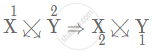
So, we get the formula as X2Y.
APPEARS IN
RELATED QUESTIONS
What type of bond is formed between two atoms, when the electronegative difference between them is High ?
Match the column A with Column B.
|
Column A |
Column B |
|
(i) Sodium chloride (ii) Ammonium ion (iii) Carbon tetrachloride |
Covalent bond Ionic bond Covalent and coordinate bond |
The following table shows the electronic configuration of the elements W, X, Y, Z:
|
Element |
W |
X |
Y |
Z |
|
Electronic |
2, 8, 1 |
2, 8, 7 |
2, 5 |
1 |
Answer the following question based on the table above:
What is the formula of the compound formed between W and X.
State the following is a reduction reaction or oxidation reaction.
\[\ce{Cu -> Cu^2+}\]
Explain fractional atomic mass. What is the fractional mass of chlorine?
Give reason
`""_17^35"CI"` and `""_17^37"CI"` do not differ in their chemical reactions.
Draw orbit structure diagram of calcium oxide (CaO).
What do you understand by redox reactions?
State the type of bonding in the following molecules.
Water,
How many electrons are required or released by each atom in water molecule to attain the nearest noble gas configuration?
