Advertisements
Advertisements
प्रश्न
Five atoms are labelled V to Z
| Atoms | Mass Number | Atomic Number |
| V | 40 | 20 |
| W | 19 | 9 |
| X | 7 | 3 |
| Y | 16 | 8 |
| Z | 14 | 7 |
- Which one of these atoms
(1) contains 7 protons;
(2) has an electronic configuration 2, 7? - Write down the formula of the compound formed by atoms X and Y.
Advertisements
उत्तर
(i) As Z has atomic number of 7, hence it has 7 protons. Electronic configuration of 2, 7 means the atom has 2 + 7 = 9 electrons. Therefore, element W has electronic configuration 2, 7 since its atomic number is 9.
(ii) Number of electron in X is 3. Therefore, electronic configuration = (2, 1). As X will try to lose 1 electron to attain stable state, hence, X has valency [1+]
Number of electron in Y is 8. Therefore, electronic configuration = (2, 6). As Y will try to gain 2 electrons to attain stable state, hence, Y has valency [2−]
Since the valency of X is 1+ and valency of Y is 2−
Formula of the compound:
X1+ Y2−
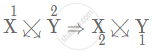
So, we get the formula as X2Y.
APPEARS IN
संबंधित प्रश्न
How do atoms attain noble gas configuration?
In term of electron transfer, define Oxidation
Fill in the blanks.
The electrovalent bond or ionic bond is called as _____ bond
What is an α (alpha) particle?
Explain
Duplet rule for the formation of hydrogen
Draw the geometric atomic structure of the following atom showing the number of electrons, protons and neutrons in them:
\[\ce{^23_11Na}\]
What is meant by a chemical bond?
Complete the following table:
| Atoms | Atomic number | Electron distribution | |
| 1. | O | 8 | ______ |
| 2. | N | ______ | ______ |
| 3. | ______ | 17 | ______ |
| 4. | ______ | ______ | 2,8,2 |
How many atoms of each kind are present in the following molecule:
Chlorine
How many atoms of each kind are present in the following molecule:
water
