Advertisements
Advertisements
प्रश्न
\[\ce{^24_12Mg}\] and \[\ce{^26_12Mg}\] are symbols of isotopes of magnesium.
(a) Compare the atoms of these isotopes with respect to :
i. the composition of their nuclei
ii. their electronic configurations
(b) Give reasons why the two isotopes of magnesium have different mass numbers.
Advertisements
उत्तर
(a) i.
|
|
\[\ce{^24_12Mg}\] |
\[\ce{^26_12Mg}\] |
|
|
|
|
|
No. of electrons |
12 |
12 |
|
No. of protons |
12 |
12 |
|
No. of neutrons |
24 - 12 = 12 |
26 - 12 = 14 |
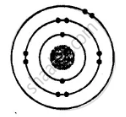
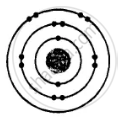
Hence, the composition of nuclei
\[\ce{_12Mg^24->(P,n),(12+12)_12Mg^26->(p,n)(12+14)}\]
ii. Electronic configuration = 2, 8, 2
(b) Mass numbers of two isotopes of magnesium are different because of the different number of neutrons, i.e. 12 and 14, respectively.
संबंधित प्रश्न
Complete the following:
| Sodium | Phosphorus | Carbon | |
| Formula of chloride | |||
| Nature of bonding | |||
| Physical state of chloride |
Fill in the blank.
___________ single covalent bonds are formed between the carbon and chlorine atoms.
Element X is a metal with a valency 2. Element Y is a non metal with a valency 3.
(a) Write equations to show how X and Y form ions.
(b) If Y is a diatomic gas, write the equation for the direct combination of X and Y to form a compound.
Elements X, Y, and Z have atomic numbers 6, 9 and 12 respectively. Which one :
State type of bond between Y and Z and give its molecular formula.
Name the following:
The shell closest to the nucleus of an atom
Complete the following table relating to the atomic structure of some elements.
|
Element Symbol |
Atomic Number |
Mass Number |
Numbers of neutrons |
Number of Electrons |
Number of Protons |
|
Li |
3 |
6 |
|
|
|
|
Cl |
17 |
|
20 |
|
|
|
Na |
|
|
12 |
|
11 |
|
Al |
|
27 |
|
|
13 |
|
S |
|
32 |
16 |
|
|
Write the formula of its (X)
sulphate
nitrate
phosphate
carbonate
hydroxide.
Identify the following reaction as either oxidation or reduction:
Zn → Zn2+ + 2e-
Sodium having atomic number 11, is ready to ______ electron/ electrons to attain the nearest noble gas electronic configuration.
Write the basic concept of Kossel – Lewis theory.
