Advertisements
Advertisements
प्रश्न
Five atoms are labelled V to Z
| Atoms | Mass Number | Atomic Number |
| V | 40 | 20 |
| W | 19 | 9 |
| X | 7 | 3 |
| Y | 16 | 8 |
| Z | 14 | 7 |
- Which one of these atoms
(1) contains 7 protons;
(2) has an electronic configuration 2, 7? - Write down the formula of the compound formed by atoms X and Y.
Advertisements
उत्तर
(i) As Z has atomic number of 7, hence it has 7 protons. Electronic configuration of 2, 7 means the atom has 2 + 7 = 9 electrons. Therefore, element W has electronic configuration 2, 7 since its atomic number is 9.
(ii) Number of electron in X is 3. Therefore, electronic configuration = (2, 1). As X will try to lose 1 electron to attain stable state, hence, X has valency [1+]
Number of electron in Y is 8. Therefore, electronic configuration = (2, 6). As Y will try to gain 2 electrons to attain stable state, hence, Y has valency [2−]
Since the valency of X is 1+ and valency of Y is 2−
Formula of the compound:
X1+ Y2−
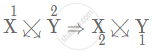
So, we get the formula as X2Y.
APPEARS IN
संबंधित प्रश्न
How do atoms attain noble gas configuration?
State differences between the properties of ionic compounds and covalent compounds.
How many atoms of each kind are present in the following molecules: calcium oxide, chlorine, water, carbon tetrachloride?
How many electrons are required by each atom mentioned in (a) to attain the nearest noble gas configuration?
What do you think would be the observation of `alpha` particle scattering experiment if carried out on (i) heavy nucleus like platinum (ii) light nuclei like litheum.
State the type of bond between Y and Z and give its molecular formula.
Draw the geometric atomic structure of the three isotopes of hydrogen and the two isotopes of chlorine.
Number of valence electrons in carbon is ______.
Write the basic concept of Kossel – Lewis theory.
| Name of compound | Type of compound | |
| a. | Sodium chloride | ______ |
| b. | ______ | co-ordinate covalent compound |
| c. | Methane | ______ |
| d. | Fluorine molecule | ______ |
Elements A, B and C have atomic number 17, 19 and 10 respectively.
State which one is a metal.
