Advertisements
Advertisements
प्रश्न
An atom X with atomic number 20 combines with atom Y with atomic number 8. Draw the dot structure for the formation of the molecule XY.
Advertisements
उत्तर
Atom X is Calcium with atomic number 20 and atom Y is Oxygen with atomic number 8.
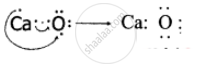
APPEARS IN
संबंधित प्रश्न
Match the atomic number 4, 8, 14, 15 and 19 with each of the following:
(a) A solid non-metal of valelncy 3.
(b) A gas of valency 2.
(c) A metal of valency 1.
(d) A non-metal of valency 4
State differences between the properties of ionic compounds and covalent compounds.
Element X is a metal with a valency 2; Y is a non-metal with a valency 3.
(a) Write an equation to show how Y forms as ion
(b) If Y is a diatomic gas, write an equation for the direct combination of X and Y to form a compound.
State the following is a reduction reaction or oxidation reaction.
\[\ce{Fe^2+ - e- -> Fe^3+}\]
Five atoms are labeled A to E
|
Atoms |
Mass No |
Atomic No. |
|
A |
40 |
20 |
|
B |
19 |
9 |
|
C |
7 |
3 |
|
D |
16 |
8 |
|
E |
14 |
7 |
(a) Which one of these atoms:
(i) contains 7 protons
(ii) has electronic configuration 2,7
(b) Write down the formula in the compound formed between C and D
(c) Predict : (i) metals (ii) non-metals
Name the following:
Two atoms having the same number of protons and electrons but different number of neutrons.
Potassium (at No.19) and chlorine (at No.17) react to form a compound. Explain the formation of the compound on the basis of oxidation.
\[\ce{^24_12Mg}\] and \[\ce{^26_12Mg}\] are symbols of isotopes of magnesium.
(a) Compare the atoms of these isotopes with respect to :
i. the composition of their nuclei
ii. their electronic configurations
(b) Give reasons why the two isotopes of magnesium have different mass numbers.
Copy and complete the following table relating to the atomic structure of some elements:
| Element | Atomic Number | Mass Number | Number of protons | Number of Neutrons | Number of Electrons |
| Beryllium | 4 | 9 | |||
| Fluorine | 9 | 10 | |||
| Sodium | 12 | 11 | |||
| Aluminium | 27 | 13 | |||
| Phosphorus | 31 | 15 |
Sodium having atomic number 11, is ready to ______ electron/ electrons to attain the nearest noble gas electronic configuration.
