Advertisements
Advertisements
प्रश्न
An atom X with atomic number 20 combines with atom Y with atomic number 8. Draw the dot structure for the formation of the molecule XY.
Advertisements
उत्तर
Atom X is Calcium with atomic number 20 and atom Y is Oxygen with atomic number 8.
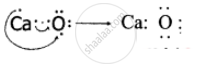
APPEARS IN
संबंधित प्रश्न
What type of bond is formed between two atoms, when the electronegative difference between them is low ?
State the following is a reduction reaction or oxidation reaction.
\[\ce{Fe^2+ - e- -> Fe^3+}\]
What is the contribution of the following in atomic structure?
Democritus
Explain fractional atomic mass. What is the fractional mass of chlorine?
Name the following:
The shell closest to the nucleus of an atom
Give the orbital diagram of the following:
Hydrogen chloride
State the type of bonding in the following molecules.
Calcium oxide
Draw the geometric atomic structure of the following atom showing the number of electrons, protons and neutrons in them:
\[\ce{^31_15P}\]
The element that would form cation due to the loss of electrons during the chemical reaction is ______.
Elements A, B and C have atomic number 17, 19 and 10 respectively.
State which one is chemically inert.
