Advertisements
Advertisements
Question
An atom X with atomic number 20 combines with atom Y with atomic number 8. Draw the dot structure for the formation of the molecule XY.
Advertisements
Solution
Atom X is Calcium with atomic number 20 and atom Y is Oxygen with atomic number 8.
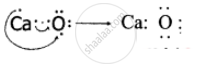
APPEARS IN
RELATED QUESTIONS
Element X is a metal with a valency 2. Element Y is a non metal with a valency 3.
(a) Write equations to show how X and Y form ions.
(b) If Y is a diatomic gas, write the equation for the direct combination of X and Y to form a compound.
Name an element which does not contain neutron.
Name the following:
The shell closest to the nucleus of an atom
An element M burns in oxygen to form an ionic compound MO. Write the formula of the compounds formed if this element is made to continue with chlorine and sulfur separately.
State the type of bonding in the following molecules.
Water,
Five atoms are labelled V to Z
| Atoms | Mass Number | Atomic Number |
| V | 40 | 20 |
| W | 19 | 9 |
| X | 7 | 3 |
| Y | 16 | 8 |
| Z | 14 | 7 |
- Which one of these atoms
(1) contains 7 protons;
(2) has an electronic configuration 2, 7? - Write down the formula of the compound formed by atoms X and Y.
Sodium having atomic number 11, is ready to ______ electron/ electrons to attain the nearest noble gas electronic configuration.
The element that would form anion by gaining electrons in a chemical reaction is ______.
The element that would form cation due to the loss of electrons during the chemical reaction is ______.
Choose the odd one out and write the reason:
